Players to Avoid: Who Not to Draft in Fantasy Football
Don't Start Your Team with a Disadvantage
There are two main things you need to do in your draft:
- Target upside
- Avoid landmines
We spend a lot of time pointing out the upside plays to you. Now it’s time to highlight who not to draft in fantasy football.
Last year we used this space to circle C.J. Stroud, Nick Chubb, Devin Singletary, Michael Pittman Jr., and Sam LaPorta -- and then put a red slash through them on draft sheets.
So who’s the 2025 crop ready to let you down at ADP? Let’s get to it.
Fantasy Football Players to Avoid in 2025
TIP
Our top Fantasy Football Bust doesn't appear on this list, but he's certainly another player to avoid for 2025.
Baker Mayfield, QB, Tampa Bay Buccaneers
This one’s pretty simple, actually.
You might see that Mayfield’s going seventh in ADP and think that seems fair after he finished third among fantasy QBs last season. But you’d be wrong.
Mayfield feasted on TD luck in 2024. His 7.2% TD rate was the seventh-highest mark of the past 10 years, among 228 QB seasons of 400+ pass attempts. Mayfield himself entered the year with a 4.6% career TD rate and posted a 4.9% in his first Tampa Bay campaign.
If we keep everything else the same from 2024 but give Mayfield that 4.9% TD rate, he loses 13 TDs and dips to QB7 in fantasy points per game.
That ADP might still seem fair. But we need to look at one more area.
Oh, You’re a Runner Now?
Mayfield entered 2024 with career highs of:
- 165 rushing yards
- 10.3 rushing yards per game
- 5.0 yards per carry (but no other season of more than 3.6)
And he had totaled seven rushing TDs six years.
But he laced up his P.F. Flyers for last season and racked up these ground numbers:
- 378 yards
- 22.2 yards per game
- 6.3 yards per carry
- 3 TDs
That amounted to 55.8 fantasy points on rushing alone, a 74% increase over his previous high. Again, even Mayfield’s first Bucs season looked much different:
- 62-163-1 rushing line
- 22.3 fantasy points
Bet on corrections in both rushing and TD rate. And let someone else in your league draft Mayfield.
Jahmyr Gibbs, RB, Detroit Lions
Ooh, this one’s a little spicy. But Gibbs stands as the only Round 1 competition for our fantasy football bust of the year on my board.
Gibbs finished No. 1 among RBs in total PPR points last year and trailed Saquon Barkley by just 0.5 in points per game. But he got pretty fortunate.
Don’t Ignore David Montgomery’s Return
Gibbs’ usage and production jumped after RB David Montgomery injured a knee in Week 15. Through Week 14, Gibbs ranked sixth in PPR points per game and tied for just 20th in expected points per game.
With no Montgomery from weeks 15-18, Gibbs jumped to third in expected points and first in actual.
Montgomery’s back now. Perhaps he doesn’t reclaim as much work, but the share’s gonna at least be far different than the no-share of those final four weeks last season.
And there’s still one more issue with Gibbs’ numbers.
TD Luck Inflated Multiple Lions
Gibbs ran for 16 TDs last season. Pro Football Focus credited him with 9.9 expected TDs. The first number tied for the league lead; the latter ranked 11th among RBs. Regression’s likely coming. And not just for Gibbs.
The Lions averaged 4.0 offensive TDs per game last season, most since the Chiefs in 2018. They were just the fourth team to reach that mark since 2010, and every previous member of the group saw TD decline the following year.
If Detroit dips to the 3.3 that the others did, that’s 12 fewer team TDs for the season.
Look Elsewhere in Round 1
So Gibbs is due for:
- Workload shrinkage, thanks to Montgomery’s return
- TD regression
- And team TD regression
And that doesn’t even address the possibility that losing OC Ben Johnson harms the offense’s efficiency further.
Take that guy in the middle of Round 1, and you’re inviting risk.
3D Values Drive the Way We Look at All These Players
James Cook, RB, Buffalo Bills
That chunky extension the Bills just gave Cook makes him look like a guy they want to feed for at least the next few years. But let’s look back at the size of those meals in 2024.
Cook finished 11th among RBs in PPR points per game. But he checked in just 27th in expected points per game. That positioned him right behind Rico Dowdle, and also trailing Rhamondre Stevenson, J.K. Dobbins, and Kareem Hunt.
Cook tied for the league lead in rushing TDs but tied for just 19th in carries, 32nd in targets, and 33rd in receptions. I’m not calling him a bad player, but he scored well beyond what should be expected from the way the Bills used him last year.
Doesn’t the Cheaper Price Help?
Cook’s RB13 ADP -- up about a half-round since his extension -- doesn’t put him quite as high as last year’s scoring finish. But it also doesn’t correct him enough to make him a good value in Round 3.
Just check out his current surroundings in our ADP Market Index:
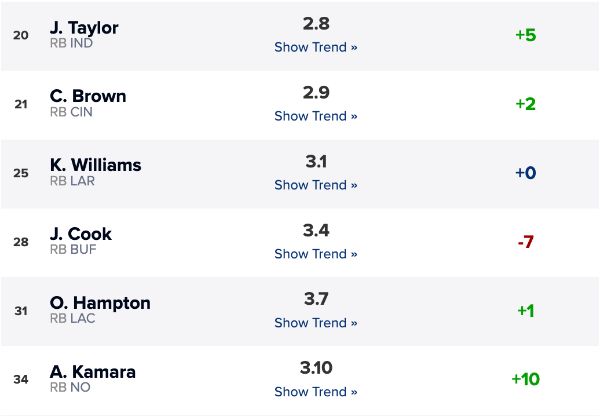
Cook needs either a significantly larger work share or another season of extreme TD luck to pay off from that range, and there’s little reason to bet on either.
What is the ADP Market Index, and Why Should You Care?
Terry McLaurin, WR, Washington Commanders
McLaurin finally got a QB in his sixth season, and that powered pretty easily the best fantasy season of his career. But he presents an issue very similar to Cook’s: The scoring didn’t match the usage.
McLaurin tallied the seventh-most PPR points among WRs. That ranking dips to 16th when you look at points per game. And expected PPR points per game? Tied for 28th.
McLaurin tied with Jordan Addison in that category, trailing Jauan Jennings, Rashid Shaheed, and Keenan Allen, among others.
Regression Risk Easy to Find
His 13 TDs were awesome. But doing that on just 7.7 expected TDs, according to PFF, gave McLaurin a league-high gap of 5.3 between those numbers. That’s screaming for regression.
If we knock McLaurin down from 13 to those eight expected TDs last year, he’s suddenly just WR27 in PPR points per game.
But why shouldn’t we just expect those juicy numbers to stick around thanks to his young, ascending QB? McLaurin ranked just 34th among all WRs in target share last season, and that was up slightly vs. the previous year (from 20.1% to 21.7%).
Enter Deebo Samuel to add easily the biggest target challenge of McLaurin’s career.
You might notice that McLaurin now sits at exactly the same level in our PPR WR rankings (WR19) as he does in consensus ADP. But it's tough to like his upside case from there for all the reasons I laid out.
Cooper Kupp, WR, Seattle Seahawks
Speaking of easy avoids … the Rams told us quite a bit about Kupp with their actions over the past year.
- First, his usage fell off. Kupp averaged 9.1 targets across the six games following his return from a five-week high ankle sprain early in the year. That dropped to 3.4 per game over his final five outings, including two playoff contests.
- Then L.A. dumped him. That move technically followed the next one on this list, but the Rams telegraphed that it was coming early in the offseason and couldn’t find any trading partners.
- The Rams replaced Kupp with someone even older. Kupp’s spot went to Davante Adams, who’s six months older than the guy he replaced and still expensive ($46 million on a two-year deal).
That sequence sure seemed to indicate that Kupp’s done … or, at least that the only team and coach he has played for in the pros don’t think he’s worth keeping around.
But it had to be good news that the Seahawks quickly swooped in to give him $15 million a year on a three-year deal, right?
Landing Spot Doesn’t Help the Vet
The quickness and size of the new contract for Kupp certainly shows that Seattle believes he’s still good. But let’s look at where he landed.
We know three things about this Seattle offense:
- It wants to run the ball more than last year. That’s been stated clearly and often following the OC switch from Ryan Grubb to Klint Kubiak.
- It’s already got a target leader. Jaxon Smith-Njigba overtook Tyler Lockett and DK Metcalf in that area in his second season, and we’re betting the 23-year-old is still ascending.
- It’s relying pretty heavily on Sam Darnold. Perhaps the Seahawks coaches believe that’s an upgrade over Geno Smith, but we’re sure not counting it as such.
That all makes Kupp’s situation seem pretty unexciting. And I haven’t even gotten to his specific age yet.
At the Edge of the Age Cliff
Kupp turned 32 in June. Our historical player-aging data finds WRs across archetypes producing well below 90% of their fantasy peaks at that age, with risk of falling off the cliff, depending on what bucket Kupp belongs in at this stage.
Seattle needs only look back at last year to see Lockett scoring a career-low 7.1 PPR points per game in his age-32 campaign, a 39% drop from his previous season, which had already fallen 22% from the year before that.
Who SHOULD You Draft?
We just ran through some fantasy football players to avoid. So who should you target instead?
Well, we answer that in a lot of different ways -- such as in the Draft Guide video below.
Your best answer, however, will come from your custom-fit Draft War Room.