Production & Fantasy Finishes
Loveland reeled in 58 balls for 713 yards and 6 TDs across 16 games last year, finishing 16th among TEs in PPR points per game and 15th in half-PPR.
Loveland’s production trended up throughout his rookie season. He ranked just 48th at his position in PPR points per game through Week 8. But from Week 9 through 18, Loveland scored as the TE5.
And he closed the season strong. Over his final four games, including the playoffs, Loveland averaged:
- 7.0 catches
- 94.5 yards
- 0.5 TDs
Usage & Role
Loveland opened the season behind TE Cole Kmet, running fewer routes than the veteran in each of Chicago’s first three games.
Loveland edged Kmet in routes (39% to 30%) coming off the Week 5 bye and then topped a 51% route rate in each of his final 12 games.
Loveland didn’t truly capture a full-time role until Week 16, though. Over his final five games, including the playoffs, he:
- Ran a route on 80% of pass plays
- Drew a 25.1% target share
- Averaged 19.1 expected PPR points per game
For perspective, Trey McBride led all TEs last year with a 25.4% target share and 18.6 expected PPR points per game.
Two more notes on Loveland’s usage last year:
- He tied for second among 38 qualifying TEs with a 9.5-yard average target depth.
- His 13 red-zone targets led the Bears and tied for 13th among all TEs.
Efficiency & Regression
Loveland caught 70.7% of his targets and averaged 12.3 yards per catch last year. His 8.7 yards per target ranked 10th among 39 TEs with 30+ targets.
He was just as efficient on a per-route basis. Among those 39 TEs, Loveland ranked:
- 10th in targets per route (0.22)
- fifth in yards per route (2.00)
Even more exciting is that Loveland’s per-route efficiency improved when his role expanded late in the season. Over his final five games, including playoffs, he averaged:
- 0.31 targets per route
- 2.49 yards per route
Loveland also popped in film-based metrics. Among those 39 TEs, he ranked:
- seventh in Fantasy Points separation score
- 21st in ESPN receiver score
- third in Pro Football Focus receiving grade
Offensive Context
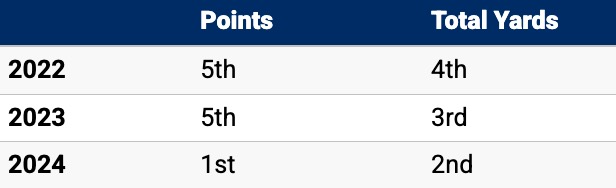
The 2025 Bears finished sixth in total yards and ninth in points. It was a run-leaning offense, ranking:
- 24th in pass rate
- 21st in neutral pass rate
- 20th in pass rate over expected
But the Bears ranked sixth in offensive pace (seconds per play) and second in total plays. That vaulted them to 10th in pass attempts.
QB Caleb Williams had an uneven sophomore season. He flashed his ceiling on plenty of occasions but also ranked 36th or worse among 42 qualifying QBs in:
- Completion rate
- Adjusted completion rate
- Completion rate over expected
- On-target pass percentage
Loveland’s 75% catchable-target rate ranked 36th among 39 qualifying TEs.
Historical Production & Trends
Loveland was the 10th pick of the 2025 draft, four spots ahead of TE Tyler Warren.
Loveland never matched Warren in raw college production because he played on super run-heavy Michigan teams. Even so, he finished second among Wolverines in receiving yards (649) and TDs (4) as a true sophomore before leading the team in both categories as a junior (582 yards, 5 TDs).
Loveland’s career 49.6% college dominator (share of team’s receiving yards and TDs) was a 100th-percentile mark at his position, according to Player Profiler.
Injury History & Durability
Loveland played most of his final college season with a dislocated AC joint in his right shoulder and had surgery in January 2025. That prevented him from working out prior to the NFL Draft and sidelined him last spring. Loveland was ready for training camp, though, and had no shoulder issues as a rookie.
He missed Week 4 with a hip injury and sustained a concussion in Chicago’s playoff loss to the Rams. That was Loveland’s second documented concussion, with the first coming in November 2024.