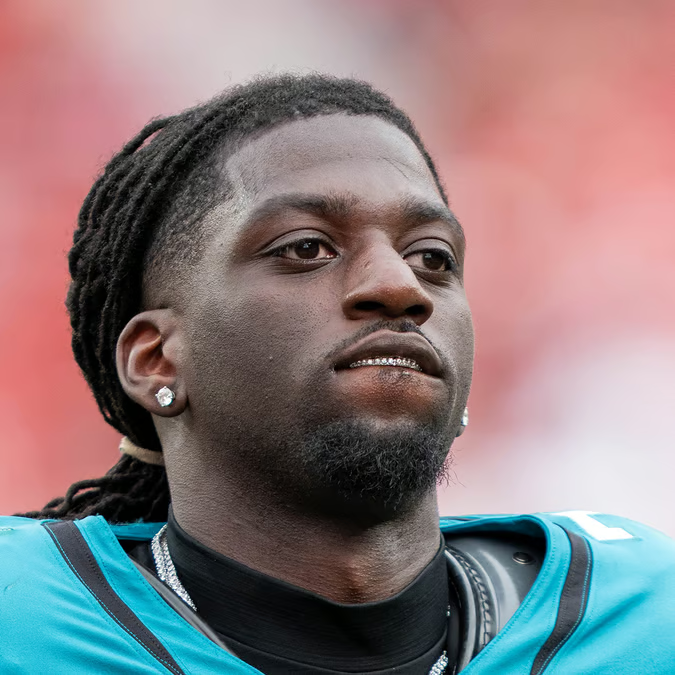
Production & Fantasy Finishes
Thomas' 2025 season looked nothing like his promising rookie year. After finishing WR7 at 15.8 points per game in 2024, he fell to WR42 with just 9.9 points per game across 14 contests in 2025. Nearly every key metric went backward.
Metric | 2024 | 2025 |
Target Share | 24.4% | 18.6% |
Targets Per Route | 0.247 | 0.187 |
Yards Per Route Run | 2.45 | 1.50 |
PFF Receiving Grade | 83.4 | 66.7 |
ESPN Receiver Score | 57 | 17 |
Expected PPR PPG | 14.3 | 11.7 |
Actual PPR PPG | 16.5 | 9.9 |
The target share drop from 24.4% to 18.6% coincided with the arrival of Jakobi Meyers and the emergence of Parker Washington, both of whom cut into Thomas's role.
In his first eight games, Thomas caught just 50% of his targets (66th) at 13.5 yards per catch (25th) and 6.8 yards per target (55th). His 20.9% target share over that period led the team (before Meyers arrived).
Over his final six games, with the entire offense hitting its stride post-bye, those numbers improved to a 58.1% catch rate (29th), 15.9 YPC (ninth), and 9.3 yards per target (13th). But, his 14.9% target share over that period still ranked third behind Meyers and Washington. The late-season uptick coincided with Lawrence's (QB1 over that period) post-bye surge and the offense finding its rhythm, which offers some reason for optimism heading into 2026.
Just as telling was the gap between his 11.7 expected PPR points per game and his 9.9 actual. Jakobi Meyers fell slight short at 11.0 fantasy points per game vs. 11.4 Expected, but that certainly wasn’t the gap that Thomas had. Parker Washington actually exceeded his expected fantasy points per game scoring 11.5 vs. 11.2 expected.
Usage & Role
Part of what changed was how the offense used him. Thomas shifted toward more of a pure deep threat in 2025, with his aDOT climbing from 11.4 yards (33rd among 84 WRs with 50+ targets) in 2024 to 14.5 yards (fourth among 76 WRs) in 2025.
Thomas drew 34.6% of Jacksonville’s air yards, 11th-highest in the league. That means the opportunity volume was there, but his 54.5% catch rate (67th) and 52nd-ranked PFF receiving grade show he wasn't converting those opportunities consistently. A deep threat who doesn't catch the ball is more of a decoy than a weapon.
Efficiency & Regression
When comparing Thomas to the rest of Jacksonville's receiving group, the gap in production metrics is clear:
Receiver | PFF Rec Grade | YPRR | TPRR |
Parker Washington | 83.0 | 2.06 | 0.214 |
Jakobi Meyers (w/ JAC) | 78.2 | 1.71 | 0.208 |
Travis Hunter | 62.7 | 1.32 | 0.191 |
Brian Thomas Jr. | 66.7 | 1.50 | 0.187 |
Thomas ranked last or near last in every efficiency category among the group. Washington and Meyers were clearly ahead of him in 2025, and Hunter's presence as a two-way player adds yet another target competitor to the mix if the team keeps him on offense at times.
Brenton Strange also continues to be a target with his 15.0% target share for the season being in line with the WR group.
Injuries likely played some role in the downturn. Thomas played through a Week 2 wrist injury and a Week 7 shoulder injury, then missed three games after a Week 9 ankle sprain.
Thomas saw a drop in his fantasy scoring after the ankle injury. From Weeks 1-9, he scored 10.7 PPR fantasy points per game. That dropped to 8.9 from Weeks 13-18 after returning from the injury. The ankle injury also coincided with the arrival of Meyers as well as Washington’s emergence, putting a further damper on Thomas’ opportunity.