Projected Role & Competition
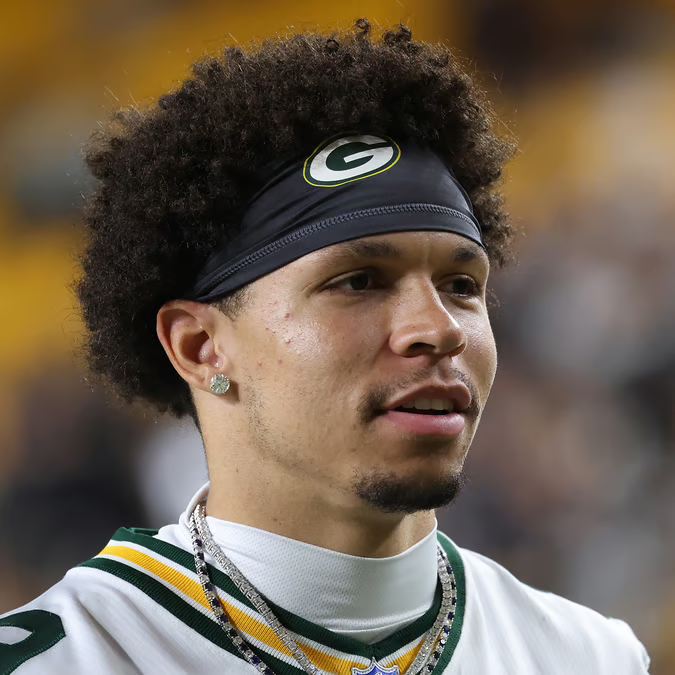
Watson enters 2026 as Green Bay’s primary downfield WR and likely No. 1 WR on the depth chart.
The team still has other viable weapons, including slot-heavy Jayden Reed and second-year WR Matthew Golden. TE Tucker Kraft was also a strong target before his ACL injury, and Jacobs earned 43 targets himself.
Watson does not need to lead this team in catches to pay off with his downfield ability, but we’re projecting him to do so.
Supporting Cast
Love is a strong fit for Watson.
He ranked eighth in intended air yards. That gives Watson a QB willing to throw the downfield passes that drive his fantasy upside.
The team is built for “11” personnel (three WRs) with Reed primarily in the slot, and Watson and Golden manning the outside. Kraft also appears to be on track for the season as he works back from the ACL tear.
That supporting cast should help Green Bay sustain drives and force teams to leave Watson in single coverage at times.
Coaching & Offensive Scheme
Since signing Jacobs in 2024, the Packers’ offense has leaned run.
| Plays Per Game | Pass Rate | Neutral Pass Rate | Pass Rate Over Expected |
2023 | 61.9 | 58.1% | 56.2% | +1.9% |
2024 | 60.4 | 48.8% | 47.8% | -4.5% |
2025 | 59.4 | 56.9% | 52.5% | -2.1% |
With Jacobs under contract through 2027, the Packers will likely continue hovering around a 50-50 run-pass split.
The scheme does attempt to push the ball downfield in the passing game. Love’s 8.8 intended air yards in 2025 ranked eighth among QBs. He ranked sixth in 2024 with 8.9 intended air yards.
Paths To Ceiling
We got top-20 per-game production from Watson last year, even though he was coming off an ACL tear. What we haven’t gotten yet is a full healthy season.
The absence of hamstring issues that past two years looks promising on that front, though. And Green Bay letting Doubs leave while trading Wicks away only helps the target outlook for Watson, who already looked like their best wideout.
His improvement over the past three years in targets per route run and yards per route run shows a WR who continues to grow and produce. Watson possesses WR1 potential if these trends continue.
Risk Factors
The biggest question with Watson obviously remains the durability. Although he avoided hamstring trouble and missed no time after his return from the ACL rehab last year, he did pop up as questionable in weeks 16 and 17.
As mentioned above, those were upper body (chest and shoulder) issues, and thus far less worrisome than the hamstring history. But we still need to get at least one full, healthy season before we can dismiss the durability concern.
It’s also worth noting that Watson played just 67.5% of the snaps over his 10 regular-season games last year. That marked the second-highest snap share among his four NFL campaigns, and it made sense for Green Bay to avoid overworking him coming off the knee repair. But we don’t yet know how high that playing time can climb when Watson’s at full health.
He can deliver useful fantasy production even if he stays short of 85% playing time, but fewer snaps obviously lowers the ceiling to some degree.