A Deep Pass Catching Group
The Chargers return six of their top seven target earners from 2025.
Keenan Allen is the lone exception, and at 34 his departure shouldn’t be a major loss. Among 56 WRs with 80+ targets last year, Allen ranked:
- 36th in yards per route run
- 38th in yards per game
- 52nd in yards after catch per reception
- 53rd in yards per catch
The Chargers should spread Allen’s targets across a deep, young pass-catching corps.
Ladd McConkey battled calf, biceps, foot, and ankle injuries during a down 2025, but he’s only 24 and just one year removed from a rookie season with 82 catches, 1,149 yards, and 2.38 yards per route run. Quentin Johnston remains volatile, but his six games of 70+ yards, team-high 8 receiving TDs, and fifth-year option pickup show the Chargers still believe in him.
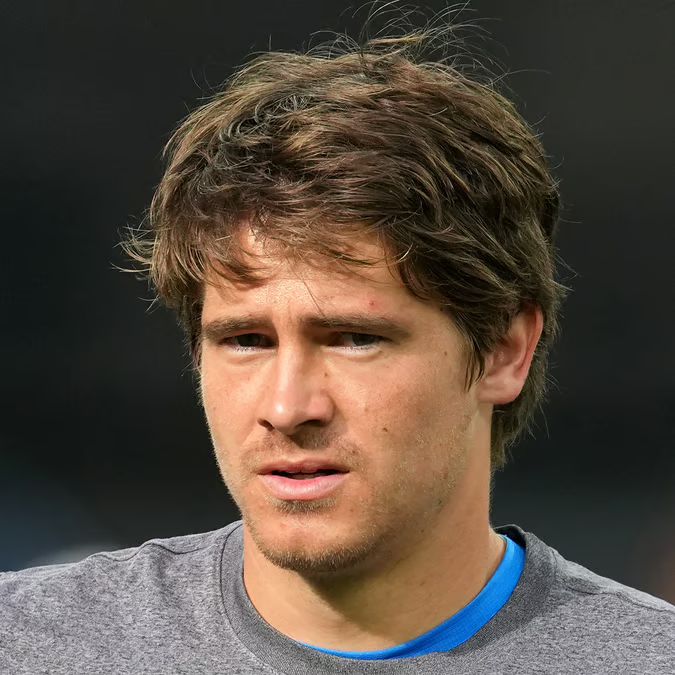
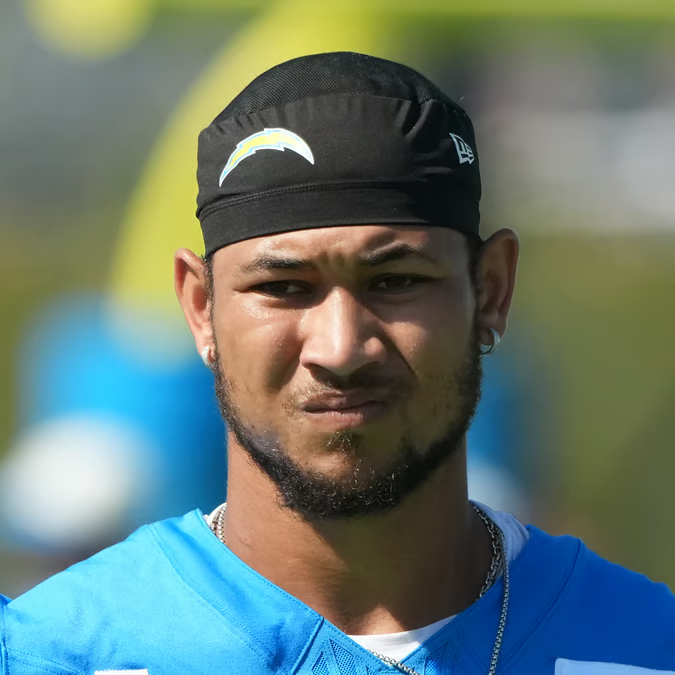
Tre Harris brings potential for a Year 2 jump, despite only 324 yards as a rookie. He supplies good size (6’2, 205), high-level athleticism (9.18 Relative Athletic Score), and strong college efficiency (3.00 yards per route run). Round 4 rookie Brenen Thompson adds 4.26 speed and a deep threat (18.6 career yards per catch in college).
The Chargers also return TE Oronde Gadsden II, who went from a Round 5 rookie to finishing fourth on the team in catches, yards, and receiving TDs. David Njoku arrives as a veteran complement, but he missed 11 games over the past two seasons and got outplayed by Round 3 rookie Harold Fannin Jr. with Cleveland in 2025.
Charlie Kolar also joins the TE room after serving as a depth piece behind Mark Andrews and Isaiah Likely in Baltimore. He should help as a blocker, with some untapped receiving ability still in play.
The O-line should improve if Slater (patellar) and Alt (ankle) stay healthy. L.A. also upgraded at C with Tyler Biadasz, who ranked 15th among 37 centers in PFF run-blocking grade last season, well ahead of retired 2025 starter Bradley Bozeman.
The guard spots are less settled, with Cole Strange, Trevor Penning, and rookie Round 2 pick Jake Slaughter battling for two spots.
McDaniel Supplies an Upgrade
Mike McDaniel enters an OC role after acting as Miami’s HC over the past four seasons.
His Miami track record doesn’t suggest a major shift from Herbert’s two years under Greg Roman:
McDaniel in Miami
| Plays | Pace | Pass Rate | Neutral Pass Rate | Pass Rate Over Expected |
| 2022 | 59.3 | 20th | 61.4% | 59.3% | +4.5% |
| 2023 | 61.9 | 27th | 56.7% | 61.3% | +2.4% |
| 2024 | 63.6 | 29th | 58.6% | 55.5% | +1.3% |
| 2025 | 55.8 | 31st | 54.5% | 54.0% | -4.2% |
Roman in Los Angeles
| Plays | Pace | Pass Rate | Neutral Pass Rate | Pass Rate Over Expected |
| 2024 | 59.8 | 32nd | 54.5% | 56.3% | +1.4% |
| 2025 | 64.4 | 27th | 57.4% | 56.3% | +3.4% |
McDaniel’s offenses peaked with a healthy Tua Tagovailoa in 2023 and 2024. Miami finished fourth in passing yards and TDs in 2023, then climbed to first in yards and fourth in TDs in 2024. McDaniel coaxing that type of production from a QB less talented than Herbert strengthens Herbert’s 2026 case.
The quick game will be worth watching. McDaniel has stressed getting the ball out of Herbert’s hands in under 2.4 seconds to offset the pass rush, which fits his Miami track record with Tua. Per TruMedia, he averaged 7.8 yards per attempt on throws under 2.4 seconds in McDaniel’s offense, ranking second among qualifiers.
Paths to Ceiling
Herbert’s setup looks stronger this time, with a deeper group of weapons, an OC who helped a lesser QB reach QB1 territory, and an O-line that should rebound if it stays healthy.
Risk Factors
The biggest concern is still the O-line. Herbert has missed just five games since 2021, but he’s absorbed too many hits while playing through various injuries. If the Chargers can’t keep the O-line intact, Herbert’s weekly floor could remain frustrating.