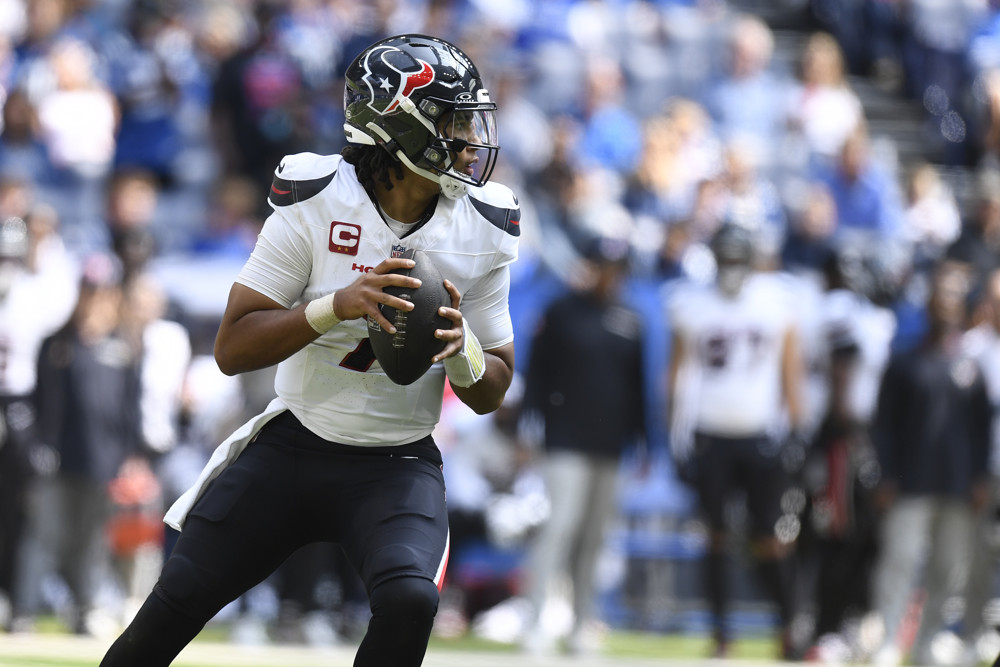
The Texans’ Fate Rests with C.J. Stroud
Houston Texans 2026 Overview
Schedule
| Week 1 | vs. BUF | Week 10 | at CLE |
| Week 2 | vs. CIN | Week 11 | vs. IND |
| Week 3 | at IND | Week 12 | vs. BAL |
| Week 4 | vs. DAL | Week 13 | at PIT |
| Week 5 | at TEN | Week 14 | at WAS |
| Week 6 | vs. JAC | Week 15 | vs. JAC |
| Week 7 | vs. NYG | Week 16 | at PHI |
| Week 8 | BYE | Week 17 | at GB |
| Week 9 | at LAC | Week 18 | vs. TEN |
Wins
2025
12
2026 Over/Under
9.5
Play Calling
| 2025 | 2026 Projections | |
| Plays Per Game | 64.0 | 62.8 |
| Pass Rate | 57.4% | 56.5% |
| Run Rate | 42.6% | 43.5% |
Key Additions
- RB David Montgomery
- G Wyatt Teller
- G Evan Brown
- C Keylan Rutledge
- OT Braden Smith
Key Departures
- WR Christian Kirk
- OT Tytus Howard
- RB Joe Mixon
- OG Juice Scruggs
Notable Coaching Changes
- None
C.J. Stroud
2025 Role & Results
Stroud Takes Another Step Back
Stroud took a step back in 2025, finishing QB22 in fantasy points per game with just eight top-12 weekly finishes.
He threw for 3,041 yards (19th among QBs), 19 TDs (21st), and 8 INts, with a passer rating of 92.9 (31st). His completion percentage of 64.5% ranked 22nd.
QB2 Volume for Stroud
Stroud ranked QB22 in expected fantasy points per game. He ranked 21st in pass attempts (400). Stroud typically targeted WR/TE over RBs with the Texans ranking eighth in WR target share (62.3%) and ninth in TE target share (23.8%). That means the passing game didn’t rely on easy checkdowns to RBs in the backfield, but more difficult passes to WRs and TEs.
Efficiency Holes in Stroud’s Profile
Stroud's efficiency remains a real concern.
He ranked 28th in yards per attempt (7.2), 40th in average depth of target (8.5 yards), and 45th in expected points added (EPA) percentage (45.3%). His low EPA percentage means that 54.7% of Stroud’s plays didn’t positively impact the Texans to score.
Stroud’s PFF pass grade of 70.0 ranked 28th and his adjusted completion rate ranked 33rd. Both of those marks, along with his overall offensive grade (72.9, 34th), have declined over the last two seasons.
Stroud’s completion percentage (63.8%) was slightly ahead of his expected percentage (62.5%). That +0.8 completion percentage over expected ranked 17th among QBs.
The Offense Stuck to Run/Pass Balance
Houston ranked eighth in pass attempts and 16th in pass rate (57.4%), operating as a relatively balanced offense. The Texans ran 64.0 plays per game (Sixth), giving Stroud a reasonable number of opportunities.
Houston ranked 19th in neutral pass rate (54.5%), and 20th in pass rate over expected (-4.29%) in 2025.
Houston threw more often under Bobby Slowik in 2023-24. Nick Caley's 2025 offense actually had the lower neutral pass rate (54.5%).
| Plays | Pass Rate | Neutral Pass Rate | |
| 2023 (Slowik) | 63.7 | 59.9% | 56.6% |
| 2024 (Slowik) | 62.2 | 60.5% | 57.4% |
| 2025 (Caley) | 64.0 | 57.4% | 54.5% |
The offensive line only made things harder. Houston ranked 22nd in PFF pass-block grade and 30th in ESPN pass-block win rate, a tough setup for any QB to overcome.
The 2023 Peak Keeps Receding
Stroud delivered a remarkable rookie year but has declined since:
| Fantasy points per game | PFF Pass Grade | Adjusted Completion % | aDOT | |
| 2023 | QB16 | 79.6 (14th) | 73.0% (21st) | 9.4 (first) |
| 2024 | QB20 | 77.6 (13th) | 72.3% (28th) | 8.6 (11th) |
| 2025 | QB22 | 70.0 (17th) | 71.4% (26th) | 8.5 (26th) |
Stroud's fantasy output and underlying metrics point to a troubling career slide. Even with a new OC in 2025, he kept trending the wrong way.
Concussion Cost Him Three Weeks
Stroud suffered a concussion in Week 9 and missed three weeks. He returned to finish the season, including both playoff games.
2026 Opportunity & Projection
Weapons Could be Strong for Stroud
The pass-catching corps is this offense's strength, led by WR Nico Collins. He finished with 1,117 receiving yards (eighth) and 121 targets (14th), plus a 31.0% air yards share (14th) and the ninth-best yards per route run among WRs with 40+ targets.
Jayden Higgins also flashed as a rookie, ranking third in PFF receiving grade among rookie WRs with 30+ targets and scoring 6 TDs. Jaylin Noel tallied the fourth-best YPRR among rookie WRs, though he never topped a 50% route rate in a game.
TE Dalton Schultz gives Stroud a reliable option after posting 82 catches (third), 108 targets (third), and 836 yards (seventh) in 2025. His 80.6% catch rate ranked sixth among TEs with 40+ targets.
Houston acquired RB David Montgomery to lead the backfield. Woody Marks returns as a No. 2 option.
The O-line remains a concern. The Texans did reshuffle it with LG Wyatt Teller, RT Braden Smith, and first-round pick C Keylan Rutledge expected to start.
The O-line additions don’t inspire confidence, with both Teller and Smith ranking in the low end of starters last season.. Teller ranked 48th among 103 Guards with 100+ snaps last season in PFF blocking grade while Smith ranked 56th among 106 Tackles. Rutledge offers upside, ranking 15th among 439 FBS Guards last season.
The Offense Didn’t Trust Stroud
Caley's first season as OC produced a more conservative offense, with both pass rate (57.4%) and neutral pass rate (54.5%) slightly falling from Bobby Slowik's previous seasons.
The neutral pass rate actually decreased In the 13 full games that Stroud played, dropping to 52.5%.
The downfield passing game has varied over the past four years looking at average depth of target:
- 2025: 8.62 (ninth)
- 2024: 8.51 (13th)
- 2023: 9.15 (fourth)
- 2022: 7.81 (20th)
The depth of targets were similar to 2024, though not quite at Stroud's 2023 rookie-year level. Even so, the Texans have stayed in the league's top half in aDOT over the past three years, a shift that followed the arrivals of Stroud and Nico Collins.
This lines up with the team’s target shares from last year with WRs earning 62.3% (eighth) and TEs earning 23.8% (ninth). RBs got the short end of the share at 13.9% (29th).
The team could also lean on the run more after trading OL Juice Scruggs plus a fourth- and seventh-round pick for David Montgomery. Montgomery gives a lead back who can handle more carries. The backfield certainly grew stronger this year with Montgomery and second-year Woody Marks compared to Nick Chubb and rookie Marks last season.
The Texans offense in Caley’s second year will likely look similar to 2025. A balanced scheme to take pressure off of Stroud and the O-line. The scheme often utilized deeper routes for Collins with short-to-intermediate dump-offs to Dalton Schultz if the O-line breaks down.
One change that could help Stroud’s fantasy season would be to regain trust from the coaching staff. That could lead to throwing more in neutral situations, helping his volume to bounce back to 2023 levels (273.9 yards per game in 2023 vs. 217.2 in 2025). Part of that may be with improved O-line play increasing Stroud’s time to throw back near 3.04 seconds per play like he had in 2023 (2.82 in 2025).
Draft Sharks Verdict:
Stroud has regressed each of the past two seasons. He has promising receiving options, so a bounce-back is possible if he can recapture his rookie-year form. But a lack of rushing upside lowers the floor and ceiling. He's fine at a QB21 ADP.
Customize Stroud’s projection for your exact league settings inside the Draft War Room.
David Montgomery
2025 Role & Results
TDs Fueled His Season
Montgomery finished 2025 with 716 rushing yards (30th), 8 rushing TDs (tied 12th), 24 receptions for 192 yards, and 164.9 PPR fantasy points (27th) across 17 games.
The TDs obviously drove his fantasy scoring, as they did his RB15 and RB16 finishes the previous two seasons.
Montgomery’s 9.5 PPR points per game in 2025 ranked just 36th among RBs. He managed one top-12 finish and six top-24 finishes before Jahmyr Gibbs pushed him aside in the second half of the season.
Montgomery Basically Disappeared from Offense Late
Montgomery set career lows in carries per game (9.3) and targets per game (1.7) in his final Detroit campaign, but the season’s two halves looked quite different.
When the Lions shifted play calling from OC John Morton to HC Dan Campbell, Montgomery's usage fell sharply. In eight games under Morton, Montgomery averaged 11.1 carries (39.2% share) and 2.1 targets (7.1% share) while ranking 24th in PPR points per game (11.6).
Over the final nine games under Campbell, that fell to 7.7 carries (32.1% share) and 1.3 targets (3.5% share), while Montgomery dropped to RB49 in PPR points per game (7.7).
The 9.3 carries per game for the season marked a significant dip from Montgomery’s previous low of 12.6 for the 2022 Bears.
There’s Hope for a 2026 Rebound, Though
A 29-year-old RB coming off a career low in carries isn’t the kind of archetype we want to chase in fantasy. Montgomery’s a little different, though. He goes from sharing a backfield with one of the league’s best RBs to a team that traded two draft picks to acquire him. Houston clearly intends to put Montgomery in the backfield lead, and touch volume remains the biggest driver of RB production.
Montgomery has shown the ability to pick up yardage after contact. He ranked in the top third of RBs with 50+ carries in YAC per attempt in each of the past three years, even improving his rate over that time:
- 2023: 3.05 (22nd among 68 RBs)
- 2024: 3.12 (23rd among 70 RBs)
- 2025: 3.17 (21st among 65 RBs)
He’s almost certainly trading down in blocking help. Detroit led the league two of the past three years in adjusted line yards, basically a measure of yards per carry attributable to the team’s blocking. Houston finished each of those years outside the top 20. But last year’s Lions slipped to 20th in that category, settling a mere four spots ahead of the Texans.
Potential Receiving Value Incoming
Montgomery’s receiving opportunities fell off in Detroit as well, which was understandable with Gibbs around.
He averaged 2.6 receptions per game across four seasons as Chicago’s lead back but then dipped to 1.7 per game over three Detroit seasons. Even that number got propped up by Montgomery’s 2.6 catches per game in 2024. He went for 1.1 and 1.4 in the surrounding campaigns.
Montgomery has performed pretty well in the passing game for his career, though. He has averaged a nice 8.2 yards per catch for his career, caught 81.1% of his targets, and even led the league in receiving success rate in 2024 (among 152 qualifiers across positions).
Success rate measures how often a player gains what’s “needed” in a given situation (40% of yards required on first down, 60% on second down, and 100% of third or fourth down).
Houston retains Woody Marks, who led last year’s backfield in receiving and racked up 261 receptions for his five-year college career. Montgomery beat Marks in PFF receiving grade and pass-blocking grade for the season, though.
We’ll see how the Texans sort roles in their renovated backfield.
2026 Opportunity & Projection
Trade Makes Montgomery a Lead Back
Houston acquired Montgomery from Detroit in March for OL Juice Scruggs, a 2026 fourth-round pick, and a 2027 seventh-round pick, a meaningful price for a backfield that needed a lead back. He enters 2026 as the clear lead runner, with Woody Marks behind him.
Montgomery should at least dominate early-down and goal-line carries, which has always been the engine of his fantasy production. The situation on the Texans could make for less TDs however.
Montgomery handled 61.5% of the Lions carries within the 5-yard line last season (compared to 38.5% for Jahmyr Gibbs). The team totaled 26 carries inside the 5 last year, and 55 carries over the last two years.
The Texans only had 21 carries inside the 5 last season, with Marks’ 9 leading the team. (He converted only one of them). The Texans totaled a mere 33 carries inside the 5 over the past two years.
That’s likely to mean fewer TD opportunities than Montgomery saw in Detroit.
O-Line Presents Biggest Red Flag
C.J. Stroud returns as the starter, but he's coming off a down year (QB22 in fantasy points per game) with declining efficiency. More importantly here, Houston's 57.4% pass rate (14th) and low RB target share (13.2%, 29th) structurally limited last year’s RB receiving production.
We’ll see if that number can climb back toward the 18.2% in 2024 (11th) or 18.9% in 2023 (15th), before Caley arrived.
The O-line's run-blocking grades are the bigger story for Montgomery. Houston ranked 21st in PFF run-block grade, 32nd in ESPN run-block win rate, and 24th in adjusted line yards, all bottom-10 marks that make it harder for any back to produce efficiently, regardless of talent.
They have reshuffled somewhat with free agents Wyatt Teller and Braden Smith expected to start along with rookie first-round pick Keylan Rutledge.
The O-line additions don’t inspire confidence. Teller ranked 39th among 103 guards with 100+ snaps last season in PFF run blocking grade while Smith ranked 73rd among 106 OTs.
Rutledge offers upside, ranking 18th among 439 FBS guards last season.
Did the Trade Signal More Backfield Focus?
Nick Caley's first season as OC in 2025 produced a conservative leaning offense. The 57.4% pass rate (16th) and 54.5% neutral pass rate (14th) both dropped in 2025 from Slowik’s previous years.
The Texans offense in Caley’s second year could look similar to 2025. It should remain a balanced scheme designed to take pressure off Stroud and the O-line, with downfield passing to Collins as the primary motor.
The one difference would be the investment in Montgomery fueling the run game. Montgomery’s a clear upgrade on last year’s version of Nick Chubb, and that enhanced backfield could mean more running for the 2026 offense.
Touch Count, Team Strength Will Determine the Ceiling
We know Houston plans to hand Montgomery the backfield lead, but two big questions will control how high his ceiling can climb:
- How large a share of the carries -- and especially targets -- will Montgomery get?
- Can the offense improve on whole and provide more TD chances?
The Texans have topped out at 13th in scoring (twice) in Stroud’s three seasons. If they can improve on that and give Montgomery the backfield receiving lead, he could easily climb into the position’s top 20 in fantasy scoring.
Poor O-line Could Be a Problem
The O-line presents the biggest risk. Houston ranked 32nd in ESPN run-block win rate last year. If it doesn’t improve on that, Montgomery will have a tough time delivering efficient rushing.
Texans RBs generated 2.73 yards after contact per attempt last year. Montgomery has beaten that rate in five of his seven pro seasons, including the past four in a row.
If the O-line leads to inefficient rushing and Montgomery continues to see limited receiving usage, he could land in low-RB3 territory and offer your team little help.
Draft Sharks Verdict:
Houston paid a decent price (fourth- and seventh-round picks) to acquire Montgomery from Detroit, signaling he'll be the lead back in 2026. He's a proven TD scorer with consistent red-zone volume, but a weak O-line and a lack of receiving upside in the offense make him look overvalued at an RB21 ADP.
Customize Montgomery's projection for your exact league settings inside the Draft War Room.
Woody Marks
2025 Role & Results
Just an Average Rookie Year
Marks opened his rookie year behind veteran RB Nick Chubb. Chubb outsnapped him in each of the first three games. Chubb injured his ribs in Week 4 allowing Marks to break out, finishing the game with 21 touches for 119 yards and 2 total TDs.
Chubb and Marks split snaps after that. Marks averaged a 40.21% snap share over the first eight weeks of the season, handling 38% of the RB carries. He did lead RBs with a 7.6% target share over that time.
His breakout in Week 4 combined with an aging and injured Chubb led to a role change. Marks outsnapped Chubb in Week 5 and 7, then he became the starting RB in Week 9.
Marks’ average snap share increased to 61.30% over the final nine weeks as a starter. He also handled 59.65% of the RB carries. His target share did dip to 5.8% over that period with less passes in general going to RBs.
The increased playing time led to three top-15 fantasy finishes in those final weeks, but Marks still struggled at times, finishing outside the top-30 RBs in six of his nine starts.
Receiving Was Better than Rushing
The efficiency picture for Marks was poor across the board. Among 51 RBs with 90+ carries, he ranked 46th in yards per carry (3.6), 34th in rush yards over expected per attempt (0.16), 46th in yards after contact per attempt, and 43rd in PFF rush grade.
His yards after contact per attempt of 2.59 ranked 46th, pointing to Marks doing little to break tackles upon contact.
Marks showed more promise as a receiver, especially after the catch. Among 43 RBs with 30+ targets, his yards after catch per reception of 9.3 ranked 12th. His PFF receiving grade ranked 27th among qualifying backs.
Marks still struggled to produce consistently through the air, ranking 33rd among RBs in yards per route run at 0.86.
His biggest weakness showed up near the goal line. Marks converted just 1 of 9 carries inside the 5-yard line into scores and finished with 5 total TDs against 6.3 expected TDs.
Texans Want to Run
Houston ranked 13th in rush attempts and 22nd in rushing yards per game (109.1), with a pedestrian 29th in yards per carry as a team.
The O-line was a hindrance on the ground, ranking dead last in ESPN run-block win rate.
The Texans ranked 27th in rushing TDs meaning the red-zone situation at RB was equally starved. Even when RBs got carries near the goal line, the offense failed to convert at a league-average rate.
The O-line's run-blocking grades are the bigger story for Marks. Houston ranked 21st in PFF run-block grade, 32nd in ESPN run-block win rate, and 24th in adjusted line yards, all bottom-10 marks that make it harder for any back to produce efficiently, regardless of talent.
Ankle Cost Him One Game
Marks played in 16 of 17 games in 2025, sitting out one game due to a sore ankle.
He also seemed to visit the blue medical tent almost every week, though he usually returned quickly. Getting nicked up that often as a rookie is worth noting, but missing only one game for the ankle is still a positive. The week he missed was the only one where he was labeled as Questionable.
2026 Opportunity & Projection
No. 2 RB at Best
Marks enters 2026 as the clear No. 2 behind David Montgomery.
Houston acquired Montgomery from Detroit in March, sending OL Juice Scruggs, a 2026 fourth-round pick, and a 2027 seventh-round pick to the Lions. That's a meaningful price for a backfield that needed a lead back. The Texans clearly envision Montgomery as their featured runner in 2026.
That leaves Marks as the No. 2 who could play on passing downs and spell Montgomery at times.
Offense Efficiency Declined
C.J. Stroud returns as the starter but is coming off a down year (QB22 in fantasy points per game) with declining efficiency. That matters for Marks because Houston's pass rate of 57.4% (14th) and low RB target share (13.2%, 29th) structurally limit what any back in this offense can produce in the receiving game.
They have reshuffled the O-line somewhat with free agents Wyatt Teller and Braden Smith expected to start along with rookie first-round pick Keylan Rutledge.
The O-line additions don’t inspire confidence, with both Teller and Smith ranking in the low end of starters last season. Teller ranked 48th among 103 guards with 100+ snaps last season in PFF run-blocking grade while Smith ranked 56th among 106 tackles. Rutledge offers upside, ranking 15th among 439 FBS guards last season.
Marks Needs Receiving Role for Ceiling
Marks' ceiling case obviously starts with a Montgomery injury.
Short of that, the second-year RB will need to retain the backfield receiving lead and grow his target volume to present any fantasy upside. If he beats the veteran for receiving duties to open the season and Houston reverses last year’s tumble in RB target share, Marks could land somewhere in the range of what Dylan Sampson (33 catches for the Browns) and Tyjae Spears (45 for the Titans, in 13 games) did last year.
They finished 42nd and 61st in PPR points per game, respectively.
He Could Just Disappear
Marks could become a non-factor after Houston traded for Montgomery. His middling 3.6 yards per carry, lack of rushing juice, and likely poor O-line could make him unusable in fantasy -- especially if the passing-game usage doesn’t increase.
Draft Sharks Verdict:
Marks proved decent in a split backfield as a rookie, but his efficiency numbers were among the worst at the position. He enters 2026 as the expected No. 2 behind David Montgomery, which limits the upside. There's not much excitement here, though he's fine as a stash in case Montgomery goes down.
Customize Marks' projection for your exact league settings inside the Draft War Room.
Nico Collins
2025 Role & Results
Just Another Top-10 Season, No Big Deal
Collins caught 71 passes for 1,117 yards and 6 TDs across 15 games, finishing eighth in receiving yards and eighth in total PPR points (224.2). His 14.95 PPR points per game ranked 11th at the position. He posted five top-12 finishes and eight top-24 finishes, landing outside the top 36 in just four of 15 outings.
Across 14 full games (omitting a partial Week 7 appearance), Collins averaged 7.9 targets (23.8% share), 4.8 catches, 77.9 yards, and 0.43 TDs per game, a WR9 pace in PPR points per game and WR14 in expected.
Downfield Role Fuels Production
Collins operated almost exclusively as an outside receiver with 79.4% of his snaps coming from wide alignment. Just 20.6% came from the slot. He ranked 14th in targets (121) and 13th in air yards share (31.0%), confirming his status as the clear alpha in Houston's passing game.
His 13.3-yard average depth of target ranked 17th among WRs with 40+ targets. That was a career high, reflecting C.J. Stroud's tendency to push the ball downfield to Collins rather than using him underneath.
Still Elite Marks Despite Decline
Collins' efficiency declined over the past two years, yet his marks remain elite vs. the rest of the league. It shows Collins’ talent continuing to shine despite declining QB play from C.J. Stroud over the past two seasons.
His 2.35 yards per route run ranked ninth among 76 WRs with 40+ targets, and his 87.4 PFF receiving grade ranked 14th. Both are three-year lows, but both still sit comfortably in the top 15 at the position.
Collins ranked seventh in yards after catch over expected (+1.1 YACOE) and won 56.7% of his contested catches (eighth), showing he can still create after the catch and win in traffic even with a deeper aDOT.
The Offense Stuck to Run/Pass Balance
Houston ranked eighth in pass attempts and 16th in pass rate (57.4%), operating as a relatively balanced offense. The Texans ran 64.0 plays per game (sixth-most in the league), giving Stroud a reasonable number of opportunities.
Houston ranked 19th in neutral pass rate (54.5%), and 20th in pass rate over expected (-4.29%) in 2025.
Under coordinator Bobby Slowik in 2023-24, the offense posted a higher pass rate and neutral pass rate. Under new OC Nick Caley in 2025, the offense seemed to get a bit more conservative.
| Plays | Pass Rate | Neutral Pass Rate | |
| 2023 (Slowik) | 63.7 | 59.9% | 56.6% |
| 2024 (Slowik) | 62.2 | 60.5% | 57.4% |
| 2025 (Caley) | 64.0 | 57.4% | 54.5% |
WRs did command 62.3% of targets (eighth), giving Collins a favorable share of targets. The offense ranked just 22nd in EPA per play (-0.017), meaning production came despite inefficiency rather than because of it.
The O-line was a liability as well. Houston ranked 22nd in PFF pass-block grade and 30th in ESPN pass-block win rate.
Three Years of Top-10-Level WR Play
Collins has been one of the more productive WRs in the league across the last three seasons when healthy. Here are his annual PPR points per game finishes:
- 2025: WR10
- 2024: WR9
- 2023: WR7
Collins has been strong across most metrics in each of those seasons.
His yards per route run has decreased slightly over each season (NFL rank among WRs with 50+ Targets):
- 2025: 2.35 (Ninth)
- 2024: 2.87 (Third)
- 2023: 3.10 (Second)
But, Collins remains atop the league each year in YPRR. That makes the decrease likely due to the decline in Stroud’s QB play over the past two seasons.
Collins had a career best aDOT this past season:
- 2025: 13.3 (15th)
- 2024: 11.7 (38th)
- 2023: 11.3 (39th)
His yards per reception were also atop the league:
- 2025: 15.7 (Fourth)
- 2024: 14.8 (17th)
- 2023: 16.2 (Eighth)
Collins’ aDOT continued to rise over the last two seasons while his yards per reception dipped from 2023. Collins did more after the catch in 2023 at 6.9 yards after catch per reception vs. 4.6 in 2025.
Collins consistently performs as a top-ten NFL WR.
Recurring Pattern of Minor Injuries
Collins has dealt with relatively minor injuries in each of his NFL seasons.
He missed one regular season game in 2025 due to a Week 7 concussion.
He missed five games in 2024 due to a hamstring injury and two games in 2023 due to a calf injury.
There are no major concerns for Collins heading into 2026, but he has lost at least one game to injury in each of his five NFL seasons.
2026 Opportunity & Projection
No. 1 WR Role Locked In
Collins returns as Houston's clear No. 1 WR, with no worrisome challenge to his target share.
He’ll still have to deal with Stroud, whose performance decline the past two years has damaged the offense on whole more than Collins’ fantasy output.
Nick Caley’s Balanced Attack Still Runs Through Collins
Nick Caley's first season as OC in 2025 produced a balanced offense by most measures. The pass rate (57.4%) and neutral pass rate (54.5%) both dropped from Slowik’s previous years. The team’s pass attempts actually increased in 2025 despite the lowering rates which fueled the highest target total of Collins’ career at 120.
Part of the reason for that was that the team did target WRs and TEs primarily when throwing the ball. WRs earned 62.3% (eighth) and TEs earned 23.8% (ninth). RBs got the short end of the share at 13.9% (29th). WR target rates have been fairly consistent since Collins’ emergence at 60.7% in 2023, and 61.0% in 2024. He clearly fuels the targets to WRs as the No. 1 WR on the team.
The Texans offense in Caley’s second year will likely look similar to 2025. A balanced scheme to take pressure off of Stroud and the O-line with downfield passing to Collins as the primary motor. When the O-line breaks down, short-to-intermediate dump-offs to Dalton Schultz make sense.
One potential change is that the team could lean on the run more after trading OL Juice Scruggs plus a fourth- and seventh-round pick for David Montgomery. Montgomery gives a lead back who can handle more carries. The backfield certainly grew stronger this year with Montgomery and second-year Woody Marks compared to Nick Chubb and rookie Marks last season.
QB Holds Key to Collins’ Top Form
Collins has scored as a top-10 fantasy WR when healthy for three straight seasons now. We know he has the talent and the role. What does he need to reach his ceiling? Two simple things:
- Health
- Improvement from Stroud
We can insure our fantasy rosters against the injury risk. Stroud’s struggles, though, have pushed Collins’ catchable target rates down from 87.1% in 2023, to 77.8%, and then 71.2%.
That 2025 number ranked 61st among 76 WRs who drew 50+ targets. Tough to maximize your output with that meager input from your QB.
Guarding Against Injury Looks Like the Key
Stroud’s poor performance the past two years challenge Collins’ weekly volatility but haven’t kept him from scoring overall.
Otherwise, Collins presents fairly low risk outside of injury. That he has missed 2+ games in each of his five seasons certainly means you should consider roster insurance after you draft Collins. But that’s not hard to secure.
Draft Sharks Verdict:
Collins continued to perform despite the lackluster Texans’ passing game and balanced offense. He finished as WR9 in PPR points per game over his 14 full outings. His sturdy floor and high ceiling make Collins a target at a WR10 ADP.
Customize Collins’ projection for your exact league settings inside the Draft War Room.
Jayden Higgins
2025 Role & Results
TDs Fueled Rookie Season
Higgins finished his rookie season with 41 receptions for 525 yards and 6 TDs across 17 games, totaling 129.5 PPR fantasy points (47th) and 7.62 per game (69th). The weekly finishes were largely invisible. He landed outside the top 36 in 10 of 17 weeks, managed just one top-12 finish, and landed among the top 26 five other times.
His six receiving scores tied for 18th among all WRs despite a mere No. 54 finish in targets (69).
Higgins Played Part Time
The usage picture explains most of Higgins' fantasy limitations in his rookie season. He reached a snap rate of 60% or higher in only seven games. He averaged just 4.9 targets (13.7% share), 2.4 catches, and 25.9 yards in those games.
Higgins’ production trended upward in the second half of the season with 5+ targets in six of the last nine games.
Higgins played almost exclusively as an outside WR (78.0% wide rate, 21.5% slot rate).
Higgins Shows Promise Among Rookie Class
Among 15 rookie WRs with 30+ targets, Higgins ranked third in PFF receiving grade, tied for fourth in yards per route run, and fifth in target per route.
His 1.45 yards per route run ranked 52nd among the 90 WRs with 40+ targets. That placed him in more of a complementary role.
Higgins' 12.4-yard aDOT (34th) and 12.8 yards per catch (41st) show some downfield ability.
The Offense Stuck to Run/Pass Balance
Houston ranked eighth in pass attempts and 16th in pass rate (57.4%), operating as a relatively balanced offense. The Texans ran 64.0 plays per game,, giving Stroud a reasonable number of opportunities.
Houston ranked 19th in neutral pass rate (54.5%), and 20th in pass rate over expected (-4.29%) in 2025.
Under coordinator Bobby Slowik in 2023-24, the offense ran with a higher pass rate and neutral pass rate. Under new OC Nick Caley in 2025, the offense actually ran the most plays per game but with a lower neutral pass rate (54.5%), signaling a more conservative approach even in neutral game scripts.
| Plays | Pass Rate | Neutral Pass Rate | |
| 2023 (Slowik) | 63.7 | 59.9% | 56.6% |
| 2024 (Slowik) | 62.2 | 60.5% | 57.4% |
| 2025 (Caley) | 64.0 | 57.4% | 54.5% |
WRs did command 62.3% of targets (eighth), at least creating a larger pool of targets.
2026 Opportunity & Projection
Higgins Looks Like a Starter
Higgins should start opposite Collins after the Texans made no meaningful WR additions in the offseason.
Christian Kirk, who matched Higgins in targets per game last year, has gone to San Francisco. Xavier Hutchinson should continue to get some snaps, but Higgins leap-frogged him on the depth chart as a rookie. Tank Dell also remains on the team, despite not having played since Week 16 of 2024. Dell participated in offseason workouts and could work in a rotation, but there isn’t a strong indication that he will come back at 100%. Jaylin Noel should see his role grow, but he works primarily from the slot and thus presents less direct competition for Higgins.
The question is less about competition and more about whether the coaching staff expands his role.
HC Demeco Ryans has been talking positively about Higgins and his potential role: “[He is] going to have a great year. He has lined up at multiple spots. He’s playing stronger. He’s making all of the tough catches. He’s playing extremely fast."
Nick Caley’s Offense Gives Higgins a Path to More Targets
Houston’s switch from Slowik to Caley at OC met with the pass rate lowering a bit in 2025, both overall and in neutral situations. But the enhanced offensive pace and dramatically lower sack rate (5.1% from 8.65%) actually produced more team pass attempts than in 2024.
The Texans targeted WRs on 62.3% of attempts, eighth-highest in the league. More of that would obviously be good news for Higgins. And despite Stroud’s struggles, the Texans ranked ninth in aDOT. That’s also positive for Higgins, whose 12.4-yard aDOT conveys the downfield nature of his game.
This year’s Texans offense would probably like to see more targets shift from TE Dalton Schultz to a more dynamic player such as Higgins. Why? Because the second-year wideout will present more big-play promise and better per-catch yardage efficiency.
Drafting Higgins early in Round 2 last year signals the team’s belief in his abilities.
Of course, we also need to acknowledge RB David Montgomery’s arrival. That trade plus the second-round selection of TE Marlin Klein -- more run blocker than pass catcher at Michigan -- could signal a plan to run the ball more.
We’ll have to watch throughout summer for indications of the anticipated run-pass split.
Higgins Progressing Raises His Ceiling
If he wins the No. 2 job, Higgins should compete for the No. 2 ranking in targets. Schultz occupied that spot last year, but he jumped from 16th and 17th among TEs in target share the previous two years to 11th last season.
Houston’s offense would be better off if a dynamic young WR beats Schultz in targets.
The offense showed in 2024 it could support multiple WRs when Nico Collins and Stefon Diggs both ranked among the top 18 in PPR points per game, even with Stroud playing lackluster ball.
Of course, improved performance from Stroud would help everyone on offense.
He Could Fall Behind Other Weapons
Although we expect Higgins to earn a full-time role, there’s the chance he disappoints this summer. Houston has enough options that it won’t need to force the ball to a second-year wideout who isn’t developing quickly enough.
Continued issues for Stroud could also particularly hamper his ability to consistently deliver intermediate and deep shots to Higgins. Those plays take longer to develop than shorter-range throws, and thus require adequate blocking and competent QB play.
Draft Sharks Verdict:
Higgins showed genuine promise as a rookie, but the Texans will remain a balanced offense that targets Nico Collins heavily. Higgins’ path to a breakout in Year 2 runs through a larger snap and target share. He's a fine dart throw anywhere in WR5 range (or later).
Customize Higgins’ projection for your exact league settings inside the Draft War Room.
Jaylin Noel
2025 Role & Results
Production Lacking as a Rookie
Noel caught 26 passes for 292 yards and 2 TDs across 17 games, totaling 68.4 PPR fantasy points (91st) and 4.89 per game (118th).
Noel saw limited playing time all season, topping out at 43.4% of snaps in Week 7 (with Christian Kirk out). He did draw 13 of his 35 targets for the season (37.1%) across that game and the ensuing week that Kirk missed as well.
Noel Worked from the Slot
Noel's usage was the most restricted of any Texans skill player. His 35 targets ranked 106th among WRs.
His alignment was mostly from the slot: 65.9% of routes came from the slot position (25th among WRs with 30+ targets in slot rate). He also carried the ball six times for 12 yards. It is a small sample that hints at his potential as a gadget/jet-sweep option if his role expands.
Noel Flashed some Efficiency Among Rookies
Despite the limited role, Noel's efficiency among his rookie peers was notable.
Among 15 rookie WRs with 30+ targets, he ranked fourth in PFF receiving grade, tied for fourth in yards per route run (1.45) -- tied with teammate Jayden Higgins -- and eighth in target-per-route rate. Some positive marks among his rookie peers.
2026 Opportunity & Projection
Noel Could Be Full-Time Slot
Noel's path to relevance in 2026 is straightforward in theory: He needs to replace his part-time role with a full-time slot starter job. Christian Kirk had the lead slot role last season playing 53.9% of snaps with 71.5% of his routes run from the slot.
Noel absorbing Kirk’s 4.8 PPR points per game, that would put him in WR5 territory at 8.9 ppg. Kirk also had a big playoff performance against the Steelers catching 8 of 9 targets for 144 yards and a TD. That shows potential upside of the slot role.
Noel likely won’t rise above the No. 3 WR spot, with Collins the clear No. 1 and Higgins the favorite to start opposite him outside. Noel would need to show this summer that he shouldn’t come off the field and prove he can win outside to alter that roadmap.
Tank Dell remains as well, despite not having played since suffering a severe knee injury in Week 16 of 2024. If he’s ready, he’ll likely factor into the WR rotation somehow.
Dell has run just 28% of his pro pass snaps out of the slot, but he spent 67% of his time there in his final college season. So we know he can play the slot. And if the repaired knee saps some of his long speed, Houston might prefer to move Dell inside more. At the least, his role bears watching.
Noel Could Finally Stabilize Houston’s Slot Role
OC Nick Caley's first season as OC in 2025 produced a varied offense. The pass rate (57.4%) and neutral pass rate (54.5%) both dropped in 2025 from Slowik’s previous years. The team’s pass attempts increased last year despite the rate drop.
What will the slot WR’s role look like within that offense? Tough to say. We have yet to see a full season of lead-slot play since HC DeMeco Ryans arrived.
The 2023 Texans split the role three ways -- Robert Woods, John Metchie, and Noah Brown -- with little success.
Stefon Diggs manned the slot in 2024 before tearing his ACL in his eighth game. He finished WR18 in PPR points per game.
Christian Kirk missed four games in 2025, and Noel likely cut into his playing time otherwise. They finished a clear 1-2 among Houston WRs in slot snaps for the season:
- Kirk: 271 slot snaps, 73.2% of his total pass snaps
- Noel: 145 snaps, 65.6%
Noel would also benefit if the team continues to direct targets away from the backfield. RBs got just 13.9% of last year’s looks, ranking 29th in the league. That marked a decline from 18+% shares each of the previous two seasons. So we’ll see whether this year’s Texans regress toward that level.
Path to Fantasy Irrelevance
Noel could win the No. 3 WR job and still struggle to offer much fantasy value. Combining his and Kirk’s numbers from last year would still have produced a mere 3.7 catches and 35.6 yards per game.
He’ll need to siphon some target share from Schultz -- whose been a solid player across two franchises -- and/or hope for good team passing volume.
Of course, anything near a full return for Dell would almost certainly be bad news for Noel.
Draft Sharks Verdict:
Noel was barely a fantasy factor as a rookie, never cracking a 50% snap rate in a single game. But, Christian Kirk is gone and Noel figures to be the main slot WR for the Texans. He’s worth an end of the draft flier..
Customize Noel’s projection for your exact league settings inside the Draft War Room.
Dalton Schultz
2025 Role & Results
Volume Fueled Schultz
Schultz caught 82 passes (third among TEs) on 106 targets (sixth) for 777 yards (sixth) and 3 TDs (23rd) across 17 games, totaling 177.7 PPR fantasy points (10th) and 10.45 per game (15th).
He posted seven top-10 weekly finishes, two of those were among the top 5.
Workhorse Snaps and Targets
Schultz was a true workhorse, playing 589 pass snaps, sixth most among TEs
He split time between inline and slot alignments. He had 332 inline snaps (second) with a 56.4% inline rate (13th). He also had 190 slot snaps (21st) with a 32.3% slot rate (33rd).
He ranked 14th in PFF receiving grade.
His 106 targets ranked sixth at the position, but his 6.6-yard average depth of target ranked 22nd. That checked in more than a yard shorter than either of his two previous Texans seasons and was Schultz’s shortest aDOT since his 2018 rookie campaign.
Efficiency Shows Profile Cracks
The efficiency picture for Schultz shows that he sits more as a TE2 than his raw 2025 fantasy output.
His 1.56 yards per route run ranked 19th among TEs. That’s the highest YPRR of his career. He also ranked second on the team after Nico Collins (2.35).
A lack of after-catch ability contributed to this with Schultz’s 4.4 yards after catch per reception ranking 35th. His yards after catch over expected of -0.2 (24th) confirms that lack of dynamic ability after the catch.
The Offense Stuck to Run/Pass Balance
Houston ranked eighth in pass attempts and 16th in pass rate (57.4%), operating as a relatively balanced offense. The Texans ran 64.0 plays per game (sixth), giving Stroud a reasonable number of opportunities.
Houston ranked 19th in neutral pass rate (54.5%), and 20th in pass rate over expected (-4.29%) in 2025.
The Texans directed 23.8% of targets to the TE position (ninth), so the drop in pass rate didn’t affect Schultz much. The team also increased their pass attempts in 2025 despite the dropping pass rates. That 23.8% represented a bump from 2024 (21.4%) and 2023 (20.3%).
Schultz Keeps Landing in the Same Range
Schultz has been a reliable TE over his three years in Houston. He showed the ability to rise to a low-end TE1 with enough TDs (5 in 2023 compared to 3 in 2025):
- 2025: TE15
- 2024: TE29
- 2023: TE11
Schultz saw a target share boost under OC Will Caley in 2025 that helped fuel his production:
- 2025: 17.7% (11th)
- 2024: 14.7% (17th)
- 2023: 15.7% (16th)
Gaining a higher target share and converting that into yards gave Schultz a safe TE2 environment in 2025. He showed similar production in 2023 (with more TDs) and fills the short to intermediate role in the offense well. Schultz profiles as a solid TE2 whose fantasy value is driven more by volume than playmaking.
2026 Opportunity & Projection
Starter Despite Recent Additions
Schultz returns as Houston's unquestioned TE1 with very little competition at the position.
The Texans did sign Foster Moreau and draft Marlin Klein in the second round. But Klein likely profiles as a developmental TE to take over when Schultz’s contract runs out after 2027.
Schultz Benefits from Houston’s TE-Friendly Target Split
OC Nick Caley's first season as OC in 2025 produced a balanced offense by most measures. The pass rate (57.4%) and neutral pass rate (54.5%) both dropped in 2025 from Slowik’s previous years. The team’s pass attempts increased last year despite the rate drop.
Schultz has continued to produce despite the neutral pass rate with the team targeting the TE often.
The Texans directed 23.8% of targets to the TE position (ninth), so the drop in pass rate didn’t affect Schultz much. That 23.8% was higher than 2024 (21.4%) and 2023 (20.3%). That compares to WRs earning 62.3% (eighth) RBs got the short end of the share at 13.9% (29th).
The strong TE target share benefits Schultz who has been the reliable short to intermediate receiving option for the Texans over the past three seasons.
Schultz Played at his Ceiling
Schultz’s ceiling case starts with maintaining last year’s target share, which enjoyed a boost over his previous two Houston seasons.
Beyond that, he’d need better TD luck. That helped drive his TE11 ranking in PPR points per game in 2023 (his first Texans campaign) and TE5 with the Cowboys in 2021. Schultz did garner nine end-zone targets in 2023 -- Stroud’s rookie season -- vs. nine combined over the past two years, according to PFF.
WRs Emerging Could Hurt
Schultz finished two of the past three seasons among the top 10 tight ends in total PPR points and among the top 16 in points per game. In between came a TE31 finish in points per game.
TDs drove his 2023 production. Target volume led the way in 2025. The latter could easily dissipate if the young Houston receivers improve this year. Frankly, Houston probably hopes it doesn’t need to target Schultz as much, because he’s more outlet than playmaker.
If depressed target volume meets with modest TD production, he could wind up a forgettable 2026 contributor.
Draft Sharks Verdict:
Schultz was a reliable target for C.J. Stroud in 2025, catching 82 passes, third-most among TEs. But he still lacks the efficiency and playmaking to be a consistent fantasy starter, especially after scoring just 3 TDs. He's a solid TE2.
Customize Schultz’s projection for your exact league settings inside the Draft War Room.