Don’t Trust The Box Score: What’s Wrong with These QBs? A Lot
The Box Score Lies. The Film Doesn't.
Fantasy football is all about the box score: Yards and TDs equal fantasy points, and fantasy points win your league.
But not every 5-100-1 is built the same. That’s why we use advanced analytics and film to identify talented players on the verge of delivering numbers.
Every week, I’ll bring my 22 years of experience analyzing college and NFL film to highlight when the box score doesn't match reality, showcasing a few players who performed significantly better or worse than their stats indicate.
Kyler Murray, QB, Minnesota Vikings
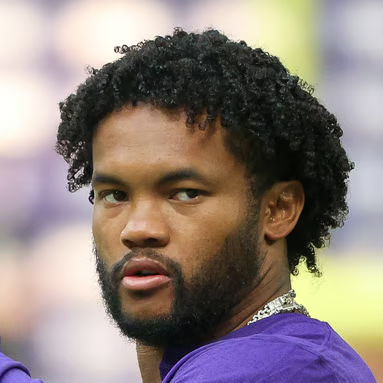

Murray missed most of Week 1 and all of Week 2 with a concussion. He has now started two games with little offensive production, throwing 1 TD to go with 1 INT and 7 sacks.
Just counting his two full games played, Murray is QB35 at 11.5 fantasy points per game.
Let’s dig into Murray’s film and identify the problems leading to a poor passing game.
Murray takes the shotgun snap and looks to his left. There are two receivers within view for his first read. T.J. Hockenson separates on the out route, but Murray passes that up to move to the middle of the field on his second read.
Jauan Jennings looks open on the drag, but the LB reads Murray’s eyes and peels off to cover that crossing route.
That gives enough time for Murray to get swallowed for a sack. He needed to hit Hockenson and was too tentative to throw the ball outside the hashes
It’s also worth noting how deep Murray gets in shotgun. His four-step drop puts him about 9 yards off of the line of scrimmage, allowing edge rushers to take a wide path and still never move past the QB.
That didn’t affect him much on this play, but there were sacks that Murray took because the edge rusher never had to engage much with the OT.
Murray often ignores more challenging throws that could result in chunks of yardage to make quicker checkdowns, even when he has extra time in the pocket.
This play has Murray looking to his left with another two routes within his view. Again, Murray ignores the deeper out route that beats the shallow zone. Instead, he checks down to Hockenson for 6 yards.
The protection was solid, giving Murray enough time for the deeper throw, but Murray appears unwilling to take chances (or take the time for deeper routes to develop).
The pressure that Murray faced (and his inability to evade it) seemed to make Murray more hesitant to hold the ball longer as last week’s game went on.
When Murray has a fast-developing deeper route, he usually can’t hit his WR accurately.
Murray steps into this throw from a clean pocket as Jordan Addison runs an in route across the middle. With a huge open zone available, he still sails the ball a bit out of Addison’s reach.
That gets Addison crushed by the LB and the pass goes incomplete.
Very few of Murray’s passes beyond 5 air yards were on target and set up the receiver for yards after the catch.
Murray can succeed when he has time to patiently find an open WR. The protection allows no penetration here, and Murray works through his progressions despite little separation from his pass catchers.
Murray stays patient and directs the drag route for a completion in stride.
But, he still appears unwilling to take that extended time to find a deeper route to throw.
Murray Valuing Safe Throws Over Scoring Points
Murray’s two games are full of plays where he passes on potentially impactful deep throws for checkdowns, or holds the ball long enough to get sacked. He appears scared of turning the ball over, and it’s hurting the offense.
That certainly could be coming from the coaching staff, which wants to lean on a strong defense. If so, that would indicate little trust in Murray.
Murray himself doesn’t appear to trust his own decision making or arm. He might be right, since deeper passes have rarely been on target so far.
He also doesn’t try to manipulate the defense at all with his eyes. Murray does go through progressions, but he ultimately stares down his targets. That hasn’t helped his WRs get open.
The myriad issues for Murray and the passing game will be difficult to fix quickly. I don’t expect a full turnaround for the offense this season.
Justin Herbert, QB, Los Angeles Chargers

One of the biggest surprises this season has been Herbert’s downfall as a passer. He has tossed only 1 TD in each of his four games, while throwing 6 INTs and taking 12 sacks.
Herbert’s 12.4 fantasy points per game ranks 32nd among QBs.
Herbert had seemed underrated to me throughout his career. He has been a talented QB facing constant pressure while often carrying the Chargers’ offense. Herbert has made difficult passes look easy and extended plays to make splash plays.
None of those things are happening this year.
Herbert throws a timing pass on this play, releasing it as Ladd McConkey completes his route. The ball gets to McConkey perfectly, but he drops it.
Short passes like this one still show Herbert’s talent as a QB. His eyes focus on the drag in the middle of the field while seeing McConkey with his peripheral vision. Herbert looks to McConkey as he winds up to throw, not tipping the defense off.
That is high-level QB play … but we’ll come back to his eye manipulation in a little bit.
There are numerous instances across the season of Herbert’s WRs letting him down on catchable passes in good locations. From McConkey to Quentin Johnston, the WRs certainly haven’t helped Herbert excel.
The lack of protection also has affected Herbert’s ability to complete passes. He faces a six-man rush on this play with only six blockers. Multiple blockers whiff on blocks, and Herbert can’t even step up to throw to the checkdown.
He looks to his right as the first read, but all of those WRs are running routes of 10+ yards. Identifying the blitz and changing the first read to the TE releasing may have at least saved the sack.
The pressure hasn’t helped Herbert’s production, but he has also shown the ability to complete passes while getting hit.
On this 3rd and 4, The Seahawks defense overloads the left side of the O-line, gaining penetration up the middle.
Herbert looks left, where a shallow route sits right at the first down marker, but he waits for the deep route to develop. That gets him crushed behind the line, but he still delivers the ball with perfect placement.
Herbert opted for the deeper route and completed it, showing his arm talent and touch. But there have also been plays under pressure where he tries to make the big play and misses the throw.
Choosing to go for the big play has also gotten Herbert into trouble at times.
This play-action pass uses a levels concept against a Cover-3 zone. Herbert has solid protection and keeps his eyes on the two levels. He has a tight window to fit the pass through the shallow zones and trusts his arm to complete the pass.
But he was wrong.
Herbert doesn’t clear the LB, leading to the INT. Also, the CB closed the gap and would have made a play on the pass if the LB hadn’t.
The problem with Herbert has been the opposite of Kyler Murray’s. Murray wants everything to be wide open and easy. Herbert often ignores the easy to throw deep passes and fit the ball into tight windows.
That also may not quite jell with OC Mike McDaniel’s offense.
Herbert May Not Be Comfortable in the New Offense
Watching Herbert this season and remembering how McDaniel ran his offenses in Miami, I worry about Herbert’s fit.
A large part of the McDaniel scheme has been using the outside WRs' deep ability to create easier coverage in the middle of the field for slot WRs. The QB can opt for the harder outside passes if the middle is covered, but he should be trying to get the ball into a WR’s hands for big yards after the catch.
Herbert often opts for those more difficult outside passes (especially when the Chargers are playing from behind) instead of staying on task for the offense.
Perhaps McDaniel’s offense has changed to the personnel, but Herbert’s preferences don’t seem to jibe with what McDaniel usually wants from his QB.
Some of the high-level parts of Herbert’s game are also lacking, specifically his eye manipulation. The earlier clip showed Herbert still using his eyes to occasionally confuse the defense, but it used to be a mainstay.
Now, only a handful of passes each game show Herbert using that to pull coverage off his target.
The film still shows elite talent, but he seems to be at odds with the offense’s goals. The lack of protection and WR drops don’t help.
It may just take more time for it to finally work. But, there should be some fear that the pairing of Herbert, McDaniel, and Jim Harbaugh is destroying Herbert’s fantasy potential.
Jalen Hurts, QB, Philadelphia Eagles
Hurts started the season fairly hot, with 5 passing TDs and 233.5 passing yards per game over his first two weeks.
The last two games have not been as impressive. Hurts averaged 123 passing yards with only 2 TDs (both in Week 4).
Hurts missed DeVonta Smith against the Rams and Dallas Goedert the past two weeks, but I wanted to dive into his film to see if the issues went beyond that.
Hurts’ strength throwing the football rests in his ability to read the defense before the snap and hit quick timing routes.
This is Hurts' ideal pass. He reads the Cover-3 defense and knows Makai Lemon will be open on his curl route. This allows Hurts to throw the ball quickly on his drop as Lemon hits the top of his route.
That renders the pressure meaningless, and Hurts gets a clean completion. But Hurts’ deep passing did make me concerned about his production with new targets.
Hurts again reads the defense well on this play. The single-high look with man coverage makes Zach Ertz the ideal target on a deep out.
Hurts identifies that and tries to loft a deep pass to Ertz. But he misreads the timing.
Ertz takes a beat to get off the CB contact, which results in Hurts overthrowing Ertz. Hurts clearly expected Ertz to peel off the CB quicker. This is where missing Goedert and Smith seems to have damaged Hurts’ production.
This type of play is almost always a completion with those two. Hurts is more in sync with them in knowing the timing.
Hurts gets credited for a TD on this play, but it was a much better catch by Darius Cooper than pass by Hurts.
Hurts rolls out and lofts a pass into the end zone. Throwing on the run does make this a difficult pass, but Cooper has a ton of space behind him. The ideal ball would have been much deeper to allow Cooper an easy catch.
Instead, Hurts underthrows the pass right to the defending DB. Luckily, Cooper recognizes it and makes an amazing catch. But this really should have been an INT, and that is completely on the QB.
His accuracy on deeper passes has been worse this year, and that’s a scary trend that could limit downfield passing production.
Hurts’ rushing ability continues to bolster his fantasy output, at least.
After his drop, Hurts identifies open space at the second level and immediately takes off through the line. He still has the burst to run through the defense and pick up chunk gains with his legs.
Hurts still holds that rushing upside, even if he has been more inaccurate than usual this season.
The injuries to Smith and Goedert certainly have hurt Hurts’ production, but the problems are not all associated with the lack of weapons. There have been more inaccurate passes this year so far than usual, and that has hurt Hurts’ raw statistics over the last two games.
His mobility and rushing ability are still there. But as the Eagles’ O-line continues to get worse, I worry that the problems will only amplify for the rest of the season. I wouldn’t expect Hurts to get back to being a top-8 fantasy QB like we have seen over the past four years.