Let's Try to Talk Ourselves Into Breece Hall as League Winner
New York Jets 2026 Overview
Schedule
| Week 1 | at TEN | Week 10 | vs. BUF |
| Week 2 | vs. GB | Week 11 | at LAC |
| Week 3 | at DET | Week 12 | at MIA |
| Week 4 | at CHI | Week 13 | BYE |
| Week 5 | CLE | Week 14 | vs. DEN |
| Week 6 | at NE | Week 15 | at ARI |
| Week 7 | vs. MIA | Week 16 | vs. NE |
| Week 8 | vs. LV | Week 17 | vs. MIN |
| Week 9 | vs. TB | Week 18 | at BUF |
Wins
2025
3
2026 Over/Under
5.5
Play Calling
| 2025 | 2026 Projections | |
| Plays Per Game | 59.4 | 61.0 |
| Pass Rate | 54.9% | 56.5% |
| Run Rate | 45.1% | 43.5% |
Key Additions
- TE Kenyon Sadiq
- WR Omar Cooper Jr.
- QB Geno Smith
- G Dylan Parham
Key Departures
Notable Coaching Changes
- OC Frank Reich replaces Tanner Engstrand
Geno Smith
The 2025 Debut Lied
Even the Good Weeks Weren’t Good Enough
Smith played 15 games in his lone season with the Raiders. It started well, with 70.6% completions and 362 passing yards in a victory at New England. That week’s QB15 fantasy finish would be one of just six times that Smith landed among the top 20.
That included just two top-12 weeks and one other higher than 17th, a fortunate QB13 finish in Week 12 against Cleveland. (Smith’s 18.1 fantasy points that week -- by our default scoring system -- would have ranked just 22nd at the position in scoring average for the season.)
Smith’s scoring average fell below all three of his Seattle seasons and even his rookie-year mark with the Jets.
The Completion Rate Held. The Downfield Juice Disappeared
Smith’s 67.4% completion rate for the Raiders stayed in line with his Seattle numbers:
- 69.8% in 2022 (his first full starting year for the Seahawks)
- 64.7% in 2023
- 70.4% in 2024
The Raiders’ limited pass-catching corps and one-year coaching staff helped limit Smith to the shortest average depth of target in his career (6.9). That led to a career low in yards per attempt and his lowest yards per attempt since the Jets days.
This Jets Move Raises the Floor, Not Much Else
One Alpha, Then Questions
Smith jumps to a Jets offense with one dominant target. WR Garrett Wilson ranked second in the league with a 30.4% target share last season after finishing top-12 each of the previous two years.
He’ll remain the No. 1, but the team would probably like him to be less dominant after drafting TE Kenyon Sadiq and WR Omar Cooper Jr. in the first round. They join WR Adonai Mitchell and TE Mason Taylor in competing for top spots.
The Jets franchised RB Breece Hall and then reached a three-year deal with him. Hall has logged the sixth-most receptions among RBs since he entered the league in 2022. That included 76 catches in 2023 and 57 in 2024. His 8.7 career yards per catch signal high-end receiving ability for the position.
It’s not a terrific group overall, but there’s enough talent to help Smith to some starter-worthy fantasy outings.
Reich’s History Says Balance
Frank Reich arrives as the new OC after Tanner Engstrand’s first year on the job got him booted.
Reich last coached in the NFL in 2023, when he got through just 11 games as Panthers HC. That team balanced the run and pass, ranking 16th in neutral pass rate. That marked Reich’s fifth straight offense to rank 16th or lower in that category.
This marked a notable shift vs. Reich’s previous five years, which included:
- Two seasons as Chargers OC
- Two as Eagles OC
- One as Colts HC
That range averaged a No. 10 finish in neutral pass rate, including three seasons of eighth or higher.
Consider Reich willing to cater to his personnel, which should leave the Jets near the middle of the league in run-pass split, game script permitting.
Put the Targets Back, and Hall Jumps
Smith’s three Seattle seasons found him ranking eighth, 24th, and 14th in fantasy points per game at the position. Can he get back to the heights of that span? Not likely.
Those Seahawks offenses started with a 25-year-old DK Metcalf and 30-year-old Tyler Lockett. The 2024 squad phased Lockett out while hitting Jaxon Smith-Njigba for 100 catches.
Garrett Wilson’s cool, but the Jets don’t come close to that group. Smith’s ceiling here is likely mid-QB2 range. Low impact.
Smith could get there by continuing his high completion rates and getting a little lucky with his passing-TD rate. Even then, we’re talking streamer at best.
The Floor Falls Fast if Wilson Misses Time
Smith also posted a career low in rushing yards per game last season. That category has fluctuated, but he fell short of 160 rushing yards in two of the past three years.
That lowers the floor for a guy who posted modest TD rates each of the past three years while increasing his INT rate each of the past two.
A Wilson injury would likely reveal a pass-catching corps that mixes lackluster talent with unproven rookies.
Draft Sharks Verdict:
Smith almost has to be better than what the Jets puked up at QB last season. He gets a better group of pass catchers than last year’s offense presented, and better than what the 2025 Raiders provided. But Smith still presents limited upside as a player, and the Jets still present little to get excited about. Treat him as a low-end QB2 across formats.
Customize Smith’s projection for your exact league settings inside the Draft War Room.
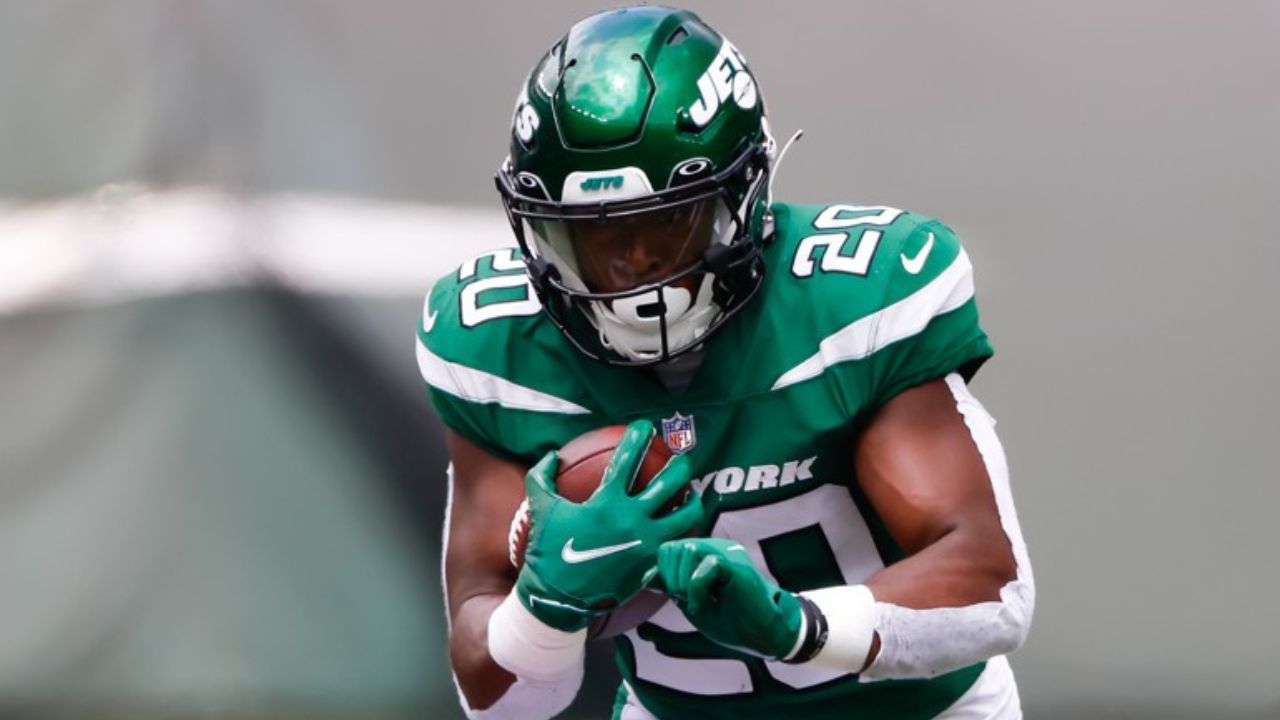
Breece Hall
More Carries, Fewer Difference-Making Weeks
An RB10 Start. Then Too Many RB3 Weeks
Hall ranked 21st among RBs in total PPR points and points per game last season. His 12.8 points per game checked in well short of any of his previous three averages:
- 2022: 16.6
- 2023: 17.0
- 2024: 14.9
Hall opened the year with an RB10 finish but reached the top 12 only four more times across 15 outings. He also finished outside the top 24 eight times, including seven weeks outside the top 30 and three outside the top 40.
More Handoffs Didn’t Replace the Checkdowns
Hall’s fantasy decline interestingly came despite a career high in carries per game. After rushing 11.4 times per outing as a rookie (including the contest he left early with an ACL tear), Hall averaged 13.1 carries each of his next two seasons and then 15.2 last year.
His carry share dipped vs. the previous two seasons, but you can blame that on the 2025 QBs accounting for more of the team’s rushing attempts.
Hall’s share of Jets RB carries hit a career high in 2025. His 77.1% cut of those attempts dwarfed Hall’s 67.4% and 69.3% shares the previous two years (all adjusted for games played).
All that QB rushing damaged his receiving output, though. Hall averaged a career-low 2.3 receptions per game, well down from 3.6 and 4.5 the previous two years. He tied for just 16th among RBs in total targets and 15th in catches while tying Jahmyr Gibbs for 11th in carries. The Jets ranked 25th in RB target share -- despite a dearth of WR options -- down from 18th in 2024 and second in 2023.
Hall fared fine when he got the ball, at least. His 9.7 yards per catch beat each of his previous two years, and his 7.3 yards per target set a career high.
Hall’s 4.4 yards per carry marked a slight rebound vs. 2024 (4.2), while his rushing-success rate climbed from 39.5% and 46.4% the previous two years to 49.8% (just shy of his 50% rookie-year high). That 2025 rate still ranked him just 25th among qualifying RBs, though.
A Better Run-Blocking Environment Changed Little
Hall’s per-carry efficiency looks just OK by other metrics as well. Among 51 RBs who carried at least 90 times last year (playoffs included), Hall ranked 29th in Pro Football Focus’ yards after contact per attempt. That rate dipped slightly from 2024, when he finished 22nd among 49 qualifiers.
Hall’s missed tackles forced per attempt have also dipped for two straight years. Here’s how they’ve progressed through his four seasons (per PFF):
- 2022: 0.19
- 2023: 0.20
- 2024: 0.17
- 2025: 0.16
That after-contact production declined despite an apparent boost in blocking help. Hall’s 2.5 yards before contact per attempt last season -- according to Pro Football Reference -- beat his numbers from each of the previous two years. And the Jets climbed from 29th in ESPN’s run-block win rate in 2024 to 14th in 2025.
Everything Around Him Was Broken
The offense on whole stunk, however. The 2025 Jets ranked:
- 29th in scoring
- 29th in total yards
- 29th in yards per play
- 32nd in expected points added per play
That environment obviously didn’t help anyone’s production and led to significant changes for 2026.
The ACL Is Old News. The Knee Still Matters
Hall’s career started roughly on the injury front. He tore the ACL and suffered meniscus damage in his left knee in Week 7 of his 2022 rookie year. Hall managed to start the next season on time but saw his workload limited through the season’s first four weeks.
The issue didn’t totally go away, though. Interim HC Jeff Ulbrich told reporters late in 2024 that Hall had been “struggling a bit” with that same knee. The RB saw his December workloads waver but missed just one game (Week 14).
Even last season found knee issues popping up on the injury report, but Hall missed only the regular-season finale en route to his career high in carries.
The Jets’ decision to franchise-tag Hall and then sign him to a three-year deal says they’re not worried about the knee going forward.
Good Setup for a Receiving Rebound
The Contract Says Featured Back
That money says Hall should keep his dominant hold on the backfield. The Jets added nothing at RB in free agency or the draft, returning Braelon Allen and Isaiah Davis as Hall’s backup tandem.
QB Geno Smith won’t excite many people as the new starter, but he should help Hall as much as anyone. Swapping out Justin Fields -- plus four Tyrod Taylor starts -- for Smith should mean a rebound in target volume for Jets RBs.
Check out Hall’s target shares through four seasons (adjusted for games missed):
- 2022: 11.6% (11th among RBs)
- 2023: 14.8% (fourth)
- 2024: 13.0% (fourth)
- 2025: 8.7% (25th)
A rebound in receiving opportunity will be vital to Hall’s production. That area has factored heavily into his fantasy success (or failure) to date.
This table shows his annual ranks in PPR points per game, the share of his production that came via receiving, and where those shares have ranked among the top 50 RBs in points per game.
| Year | PPG Rk | Rec% | Rk |
| 2022 | seventh | 40.3% | 20th |
| 2023 | sixth | 55.2% | fifth |
| 2024 | 17th | 51.6% | 12th |
| 2025 | 21st | 37.5% | 26th |
Hall finished 2023 and 2024 among the top four at his position in targets, receptions, and receiving yards. And he tied for third and fifth among RBs in receiving TDs those two years, despite his teams finishing 29th and 24th, respectively, in total points.
In addition to Smith, this year’s Jets added TE Kenyon Sadiq and WR Omar Cooper Jr. in Round 1 of the draft. But the unit still looks underwhelming and will get Frank Reich as the uninspiring new OC.
So Hall will likely continue to rely on touch volume over offensive efficiency to drive his fantasy scoring.
QB Change Could Help Hall Most
Reich has 10 years as either OC or head coach across four NFL franchises. He hasn’t served in the OC role since 2017 in Philadelphia, though.
Reich’s five years as Colts HC and (almost) one at Carolina’s helm surely found him heavily involved in offensive design. But it’s clearly not the same job as when you’re just in charge of the offense.
The results have proved mixed across Reich’s NFL offenses. Just four of them have finished higher than 16th in total yards. Four also finished higher than 16th in scoring.
His units have operated at a pretty good pace, though. Six of the 10 ranked 10th or higher in total plays. That included a four-year span of third-place finishes that spanned two franchise shifts. His 2015 Chargers, 2016 Eagles, 2017 Eagles, and 2018 Colts all ranked third.
Reich offenses have shown no discernible lean toward the run or pass. Here are his offenses’ median annual ranks:
- Rushing attempts: No. 13
- Pass attempts: 13.5
- Yards per carry: 20
- Net yards per pass attempt: 15.5
Jets passing volume will almost certainly increase in 2026. Last year’s team tied for 23rd in total plays but ranked last in situation-neutral pass rate, according to RBSDM.com, and 26th in total pass attempts.
Fields and Taylor exacerbated the issue by combining for 50 scrambles among their 430 total dropbacks, an 11.6% rate. Smith, by comparison, scrambled on only 3.4% of his dropbacks (18 or 524) in 2025.
Fewer QB scrambles in 2026 should mean more checkdowns to the proven pass catcher in the backfield.
The Ceiling Needs Carries and Targets
Hall’s clearest path to upside is keeping last year’s commanding workload share while rebounding in target volume.
Hall scored just 77 PPR points via reception last season, compared with 123.3 in 2024 and 159.1 the year before that. Swap in those tallies for last year’s deflated total and you’d boost Hall from 21st in total PPR points to RB11 or RB7.
If the Jets surprise on offense and deliver more scoring chances or Hall sees some boost in yardage and scoring efficiency, great. But the rebounded receiving usage is the piece he needs.
The Knee and the Offense Still Lurk
Just because Hall’s knee troubles didn’t scare the Jets away from committing a three-year deal doesn’t necessarily mean they’re in the past. We’ll watch this summer to see whether there’s reason to worry.
The Jets also might not meaningfully ramp up RB receiving opportunities, though some positive change there feels nearly guaranteed. The real question is how much.
Of course, if the offense remains among the league’s least productive, that would limit the upside for everyone. Hall has been able to counter that limitation in the past with better touch volume, though. That’s likely the path for 2026 as well.
Draft Sharks Verdict:
No one expects the Jets to be good on offense, which caps the upside for their lead RB. But Hall’s lackluster situation and 2025 scoring keep his ADP modest, while Geno Smith’s arrival should dramatically boost RB targets vs. the Justin Fields year. Hall’s a solid buy at cost with upside well into the top 12 in PPR formats.
Customize his projection for your exact league settings inside the Draft War Room.
Braelon Allen
An MCL Sprain Became a Lost Season
Allen’s second NFL season barely existed. He landed on IR after Week 4 with what was reported as a left MCL sprain. That injury typically doesn’t produce an IR trip, though, and commonly costs players 1-3 games.
Allen did have surgery, with an initial recovery timeline of 8-12 weeks, but he never made it back to the field. At least that followed a 17-game rookie season and a college career with no major injuries. Allen missed just four total games across three seasons at Wisconsin.
Allen’s three full games found him logging just 14 carries and 3 targets. That marked a 25.9% share of Jets RB carries. Breece Hall dominated work with a 70.4% carry share that topped his previous three seasons.
Best Case is a Handcuff Profile
Allen Has to Win the No. 2 Job First
The Jets affirmed Hall as their backfield dominator for at least the near future by applying the franchise tag this offseason and then signing him to a three-year deal.
That leaves Allen battling Isaiah Davis and Kene Nwangwu for backup roles. Nwangwu has operated almost exclusively on special teams through five NFL seasons (three with the Vikings, two with the Jets). He has tallied just 40 carries and 8 targets since arriving as a fourth-round pick in 2021.
Davis managed just 43 carries last season despite Allen going down in Week 4 and missing the ensuing 13 games. He exceeded four carries just twice, with a season-high nine coming in a lopsided Week 15 loss at Jacksonville that saw Hall get pulled before the fourth quarter.
Davis made a much larger passing-game impact, garnering 28 targets and posting a 21-186-0 receiving line. He may remain ahead of Allen in that area this season, though Allen drew 27 targets to Davis’ 12 when both were 2024 rookies.
In the three games before Allen’s injury last year, Allen beat Davis 52 to 27 in total snaps. That included a 20-12 lead for Allen in pass snaps.
Frank Reich Could Lean Into the Backfield Depth
The biggest change for the offense will be shifting from first-time OC Tanner Engstrand to NFL veteran Frank Reich.
The new/old guy comes with 10 years of experience as an NFL OC or HC. Reich’s history shows no discernible lean between pass and run, but a fully healthy Jets backfield could draw the interest of the new play caller.
Allen didn’t do anything special with 92 rookie-year carries, but he arrived as a fourth-round pick off an impressive college career that averaged 99.8 rushing yards and 1.0 TDs per game. Allen backed that up with a 95th-percentile speed score at 235 pounds at the 2024 Scouting Combine.
Davis similarly has run quiet so far in the NFL but finished his college career with two straight seasons of more than 1,400 rushing yards, 15+ rushing TDs, and 21+ receptions. He racked up 7.6 yards per carry and a 34.7% dominator rating (percentage of total team yards and TDs) across four years at North Dakota State.
We’ll watch for signals this summer of how Reich plans to run his offense, which finds QB Geno Smith at the helm instead of Justin Fields.
WR1 Volume, Better Passing, Real Top-12 Shot
Allen clearly needs Hall to get hurt as the biggest step toward reaching his fantasy ceiling.
From there, he’d need to claim the primary share of both carries and targets. The latter is where he’ll likely need to fight Davis off more.
If both those factors work in Allen’s favor, he could regularly post top-24 fantasy weeks. He probably wouldn’t be a common RB1-level candidate even in that scenario, with far less receiving upside than Hall presents.
Isaiah Davis Could Still Split the Job
Allen could find Davis passing him on the 2026 depth chart, or even just splitting the job more between rushing (Allen) and receiving (Davis).
Either of those scenarios would make him tough to like for fantasy use even in the case of a Hall injury.
Draft Sharks Verdict:
Allen’s fine as a late-round fantasy stash in case Breece Hall goes down. The starter’s knee history adds some upside there. But Allen would still find himself in a poor offense and likely facing uncertain workloads. He falls short of offering real fantasy excitement.
Customize Allen’s projection for your exact league settings inside the Draft War Room.
Garrett Wilson
Wilson Was Cooking Before Week 6
Injury Defined His Season
Wilson hyperextended his right knee late in a Week 6 loss to the Broncos. He missed the next two games and then aggravated the injury early in his Week 10 return vs. Cleveland. The Jets initially expected Wilson to miss no more than a month, but he sat out the rest of the season.
Fortunately, that marked the first significant injury of the wideout’s pro career. Wilson appeared in every game through his first three seasons, racking up 9.2 targets and 5.5 receptions per game.
Production Looked Strong Before the Knee Went
Wilson drew no fewer than 8 targets in any of his six appearances before the injury, including the aforementioned Denver contest.
He understandably struggled in that game before the injury (3 catches for 13 yards among 8 targets), but Wilson averaged a robust 6.6 receptions, 76.4 yards, and 0.8 TDs across the season’s first five contests. Those rates would have ranked seventh, eighth, and second in the league for the season.
Wilson finished four of those first five weeks among the position’s top 12 in PPR points, topping out as the second-highest scorer of Week 3.
His 30.4% target share ranked second in the league and helped offset an 80% catchable-target rate that ranked just 30th among WRs.
Can the Targets Finally Gain Accuracy?
When Geno Smith Looks Like an Upgrade …
There’s no indication that Wilson’s knee will be a problem in 2026.
“Garrett looks good; he looks really good,” HC Aaron Glenn said in late May, with Wilson participating in team workouts. “I mean, he’s typical Garrett, so that doesn’t surprise me how he’s going out there, operating. … He’s getting all of his reps.”
That should set Wilson up for another big workload. Through his first three NFL seasons, only Davante Adams and CeeDee Lamb amassed more total targets. Wilson ranked eighth over that span in receptions, 10th in receiving yards, and tied for just 36th in receiving TDs.
Blame poor QB play primarily for the production not matching the usage. Wilson’s rookie year found Zach Wilson (nine games), Mike White (four), Joe Flacco (four), and Chris Streveler (one) all starting games. The next year whittled that down to Wilson (11), Trevor Siemian (three), and Tim Boyle (two) after Aaron Rodgers tore an Achilles’ tendon in the opener.
Even when Wilson got a full season of Rodgers in 2024, the Jets mitigated the impact by acquiring Rodgers’ boo, Davante Adams after six games. Wilson went from fifth among WRs in target share (29.3%) through six games to 25th (22.8%) from Week 7 on.
New Coach Plans to Feature Wilson
The Jets dumped OC Tanner Engstrand after one season and replaced him with Frank Reich. It’s not an exciting hire, but Reich does bring 10 years of experience as an NFL OC or HC, including plenty of work with mediocre bridge-type QBs.
Reich’s five years as Colts HC started with Andrew Luck’s final season, and then included one year apiece with these guys as lead QBs:
- Jacoby Brissett
- Philip Rivers
- Carson Wentz
- Matt Ryan
Reich also served as OC for the Eagles team that scored 41 points to win a Super Bowl with Nick Foles behind center.
That’s all relevant because he’ll get Geno Smith as QB in this reclamation project. Smith won’t excite anyone -- especially after last year’s Raiders debacle -- but he’s a passing upgrade over Justin Fields and Tyrod Taylor.
‘This is My Sweet Spot’
According to Dan Pompei of The Athletic, Reich “plans to dial up wide receiver Garrett Wilson’s number frequently.” That will apparently include moving Wilson around the formation while varying play concepts.
“This is my sweet spot,” the coach said.
The Jets boosted their offensive depth chart by selecting TE Kenyon Sadiq and WR Omar Cooper Jr. in the first round, but they’ll need to prove they can challenge Wilson’s target share.
Sadiq’s an elite athlete, but he averaged just 1.9 receptions per game across three years at Oregon and didn’t break out until after TE Terrance Ferguson left (2025 second-round pick by Rams). Cooper similarly didn’t eclipse 28 catches in a season until last year at Indiana. Even then he trailed teammate Elijah Sarratt in receptions per game and TD catches.
Expect Wilson to remain among the league’s top target earners, with at least a modest boost in target quality. Smith is coming off a rough Raiders season, but even then he ranked 20th in catchable-throw rate among 45 QBs with 100-plus attempts, well ahead of Fields at 32nd. Smith ranked fifth in that category in his final Seattle campaign.
Wilson would welcome that change. Before last year’s aforementioned No. 30 ranking in catchable-target rate, here’s where he ranked among 40+ target wideouts:
- 2024 -- 59th out of 105 qualifiers
- 2023 -- 58th of 93
- 2022 -- 73rd of 98
His Best Case Still Looks Like an Occasional Starter
Wilson managed rankings of just WR31, WR34, and WR20 in PPR points per game over his first three seasons, before producing like a top-12 player at the start of last year.
He’s unlikely to sustain the 11.1% TD rate that boosted that 2025 sample. But another elite target share, strong passing volume from a Jets team likely to play from behind, and better QB play could still give Wilson a shot at top-12 scoring this year, especially in full-PPR formats.
We’ve Seen Heavy Usage End at WR3
The primary risks for Wilson include:
- The new guys commanding more target share than expected
- The team leaning run with a franchise-tagged lead RB and still lackluster QB
- Geno Smith simply deteriorating as a passer and giving Wilson more of the same crappy QB play he’s come to know in the pros
As we’ve seen before, even a healthy, heavily used Wilson could merely score like a WR3 on average.
Draft Sharks Verdict:
Wilson won’t become a “safe” fantasy bet until the Jets actually solve QB. Geno Smith’s no solution, but he should be better than 2025 Justin Fields. And another high-level target share should make Wilson at least a solid weekly PPR bet. If his target share stays among the league leaders and Smith performs more like his Seattle iteration than he did with the Raiders, then Wilson will present some upside vs. his mid-WR2 ADP. He’s a solid draft target but not someone to bet your season on.
Customize Wilson’s projection for your exact league settings inside the Draft War Room.
Omar Cooper Jr.
One Big Season Doesn’t Erase the Questions
You Didn’t Always Look Like a First-Rounder
The Jets selected Cooper 30th overall in April, but he was never an obvious candidate for the NFL Draft’s first round.
He hit college as a three-star recruit who lost the interest of some schools after a 2020 tear of his left ACL. Cooper redshirted at Indiana in 2022 and then tallied just 46 catches over the ensuing two seasons.
He broke out as a redshirt junior last fall, leading the Hoosiers in receptions (69) and receiving yards (937). But he trailed teammate Elijah Sarratt in receptions per game (4.3 vs. 4.6) and total TD catches (15-13) despite playing two more games.
Cooper’s 2025 role shifted heavily into the slot, jumping from 16.2% and 9.7% of his pass snaps there the previous two seasons to 83.3% last year. That move also cut his average depth of target from 15.1 and 16.0 to 9.2.
If the Jets view him similarly, Cooper could have trouble getting on the field early in the NFL.
Cooper Has a Path to Snaps, Not to Volume
Garrett Wilson Is Locked In. The Rest Is Up for Grabs
There’s clear opportunity but limited upside for Cooper with the Jets.
He lands on a team with a dominant target collector in Garrett Wilson. The incumbent gobbled up the league’s third-most targets across his first three seasons -- trailing only Davante Adams and CeeDee Lamb -- before losing 10 games to a knee injury last year.
Wilson’s back from that and giving no indication it’ll hamper his 2026. And there don’t appear to be defined WR roles behind him.
HC Aaron Glenn has spoken well of Adonai Mitchell this offseason, but the former second-round pick has averaged just 1.7 receptions per game through his first two seasons. Beating him for the spot opposite Wilson looks like Cooper’s best shot at meaningful rookie-year work.
If the Jets prefer Mitchell as the No. 2 WR and Cooper as the slot guy, the rookie could suffer for ramped-up 2-TE usage. New York drafted TE Mason Taylor in the second round last year and TE Kenyon Sadiq in Round 1 this April.
Too Many Mouths for Small Passing Pie
That crowded group meets with a Breece Hall-fronted backfield and a new OC, Frank Reich, who has gone pretty balanced in his offensive approach overall across 10 years as an OC or HC in the league.
QB Geno Smith should provide a passing upgrade over last year’s Justin Fields-Tyrod Taylor combo, but he’s also not likely to push the group to high-level production.
Draft Sharks Verdict:
Cooper should compete with Adonai Mitchell for 2026 playing time, but the team reportedly sought Mitchell as a piece of last year’s Sauce Gardner trade. So Cooper seems most likely to settle in as the No. 3 wideout early and fall short of fantasy relevance. Combine that with a lackluster prospect profile on a team with no long-term QB answer, and Cooper’s not especially attractive for any fantasy format.
Customize Cooper’s projection for your exact league settings inside the Draft War Room.
Adonai Mitchell
Targets Were There, Little Else Was
The Box Score Flashes Were Rare and Isolated
Mitchell spent just a year and a half with the Colts after they drafted him in Round 2, before joining the Jets as part of last year’s Sauce Gardner trade.
With New York, Mitchell posted these per-game averages across eight appearances:
- 7.3 targets
- 3.0 receptions
- 37.6 yards
- 0.3 TDs
Most of that limited production got packed into Week 13 (8-102-1, WR5 in PPR) and Week 15 (6-58-1, WR14 in PPR). He finished just one other week all season higher than WR46 but eight weeks at WR80 or lower.
Mitchell managed just a 41.4% catch rate and 5.2 yards per target over his eight games with the Jets, all of which came with WR Garrett Wilson sidelined. He’s sitting on a 43.4% catch rate and 5.9 yards per target for his two-year career.
Is There Room for Mitchell to Matter?
Coach Talk Favors Mitchell
The Jets swapped out 2025 OC Tanner Engstrand for Frank Reich, whose 10 years as an NFL HC or OC show no clear lean toward run or pass. That should leave him willing to play to his roster’s strengths.
It’s tough to say what that is for these Jets, but their 5.5 projected win total suggests plenty of trailing game scripts, which commonly boost passing volume.
Mitchell heads toward the season as the favorite for the No. 2 WR spot, though he’ll face competition.
HC Aaron Glenn said in early June, via Coachspeak Index: “Adonai Mitchell is a very talented player, and we want to squeeze every ounce of his athleticism, to where he can help us and make big plays for us, because he has that ability. He and Garrett Wilson can play off each other. Having him this whole offseason has been outstanding for us.”
That sounds like a player they anticipate running as the No. 2 receiver.
Even as WR2, Mitchell Might Not Get Enough
Mitchell will draw competition from Round 1 rookie Omar Cooper Jr., though Cooper ran almost exclusively from the slot in his breakthrough final year at Indiana. That runs counter to Mitchell’s usage, which has found him out wide on 79.6% of pass snaps through two NFL seasons, according to Pro Football Focus.
The Jets also look poised to run more multiple-TE sets in 2026. The team ran multiple TEs at the league’s fifth-lowest rate (23.1%) last year. But these Jets added TE Kenyon Sadiq with the 16th overall pick just a year after selecting TE Mason Taylor in Round 2.
The whole pass-catching group will also likely watch WR Garrett Wilson continue to draw a dominant share of targets. Wilson garnered the league’s third-most targets across his first three seasons -- trailing only Davante Adams and CeeDee Lamb -- and then ranked second in target share while losing 10 games to a knee injury in 2025.
Wilson’s back healthy, and Reich has already said he’s looking to move Wilson around the formation and feed him frequently.
The Jets also franchise-tagged RB Breece Hall and then signed him to a three-year deal at $14.5 million per year. So he’s clearly headed for plenty of work.
All told, Mitchell likely won’t see a huge target share even if he settles in as the No. 2 wideout.
QB Geno Smith should present some passing upgrade over last year’s combo of Justin Fields and Tyrod Taylor, but don’t expect this to transform into a strong or efficient passing offense.
Is There Upside Worth Chasing?
The fantasy ceiling for Mitchell would obviously include Wilson going down again. Even with that last year, he offered limited utility.
Mitchell could improve on that with better QB play and another year of NFL experience. But don’t expect the third-year wideout to become more than a bench player for fantasy rosters with a shot to pop the occasional starter-level week.
What if Mitchell Just Turns Invisible?
We’re currently projecting Mitchell and Cooper for the same 16% target share. That’s the primary risk for Mitchell, that he doesn’t separate from the rookie competitor -- and potentially even falls behind him.
Even if Mitchell emerges as the clearer No. 2 for 2026, though, Wilson’s dominant position, Hall’s receiving prowess (relative to other RBs), and upgraded talent at TE and WR limit his opportunity upside. And neither Mitchell, his new QB, nor Reich has given us reason to bet on high-end efficiency from the chances he does get.
Draft Sharks Verdict:
You can keep Mitchell stashed in a dynasty league if you want, but he presents nothing attractive for 2026 redraft rosters. You can find more intriguing upside even in the latest rounds of your drafts.
Customize Mitchell’s projection for your exact league settings inside the Draft War Room.
Kenyon Sadiq
Is Sadiq Really as Good a Prospect as You Think?
Eight TDs Masked a Mixed Receiving Profile
Sadiq broke out in his third Oregon season, leading the Ducks with 51 receptions, ranking second on the team in receiving yards (behind sixth-round Raiders WR Malik Benson), and leading all FBS tight ends with 8 TD catches.
He accounted for modest shares of the Oregon passing offense, though:
- 16.2% of receptions
- 14.7% of yards
- 25.8% of TDs
Sadiq’s 11.0 yards per catch ranked just sixth among Ducks with 10+ catches for the year. Interestingly, that per-catch average came down from his sophomore year (12.8) despite Sadiq jumping from a 2.1-yard average depth of target to 9.2, according to Pro Football Focus.
His 1.88 yards per route also ranked sixth among the same group of Ducks and marked a decline from the 2.14 Sadiq posted in 2024. Among 53 FBS TEs who drew at least 40 targets last season, Sadiq tied for a mere 17th in yards per route. Nine draft classmates at the position beat him.
Terrance Ferguson Kept Sadiq in the Background
Sadiq caught just five balls as a 2023 true freshman, following that with 24 catches as a sophomore. That tied him with RB Noah Whittington for sixth on the team, well behind lead TE Terrance Ferguson. The 2025 Round 2 pick of the Rams posted a 43-591-3 receiving line in 12 games during his final college season.
That marked Ferguson’s third straight campaign with at least 32 receptions.
Sadiq saw the share of his time spent in the slot increase each season through college, while his inline and out-wide splits each declined:
| Year | Slot | Wide | Inline |
| 2023 | 30.4% | 17.4% | 47.8% |
| 2024 | 47.3% | 15.1% | 33.6% |
| 2025 | 55.5% | 11.7% | 30.1% |
One Health Issue to Watch
Sadiq finished college with a fairly clean medical history. Jets HC Aaron Glenn did reveal this offseason, though, that the rookie TE would be having a hernia repaired and that he played through the issue in his final Oregon season.
The recovery’s not expected to keep Sadiq out of training camp or affect his regular-season preparation.
The Jets Have a Vision. Fantasy Still Needs the Details
Projected Role & Competition
Let’s start with what Glenn said just after his team drafted Sadiq (per Coachspeak Index):
“With Kenyon Sadiq, we’re gonna be able to dictate, as far as the defense is concerned, are you gonna be in base, are you gonna be in nickel? There are so many positions that he can play for us. That’s gonna make us be able to open up the offense. Frank Reich has a really, really good vision for this player. It’s gonna be exciting to have him and the rest of those tight ends in the game at the same time.”
Now let’s break that all down …
1) It can’t possibly be a bad thing for Sadiq’s immediate usage that his OC had a “vision” for the player before the team drafted him 16th overall. That points to a significant rookie-year role, although it doesn’t necessarily tell us how fantasy-friendly a role that will be.
2) “So many positions” obviously hints at the Jets moving Sadiq around the formation. That still falls short of projecting his playing time, but it does suggest the team will try to put him on the field as much as it can. Sadiq spent more snaps as a run blocker than a receiver through his first two college seasons, and nearly as many (275 blocking, 285 in route) even in his breakout campaign. PFF rated him solidly as a run blocker. So we’re not looking at a receiving-only TE.
3) “The rest of those tight ends” is interesting. We’d have bet on more 2-TE sets for the Jets this season, with Sadiq joining 2025 second-round pick Mason Taylor. But “the rest of those tight ends” ropes in at least Jeremy Ruckert (a 2022 third-rounder) as well, and perhaps Jelani Woods and FB/TE Andrew Beck.
Big plans overall for the position in the new offense should be good news for the best receiving prospect among Jets tight ends. And the Jets drafting him 16th overall certainly points to them viewing him that way.
But we can’t know for sure yet that the historically undersized Sadiq -- 21st-percentile height and 15th-percentile weight among Combine TEs -- is ready for a full-time NFL role.
And his target share will be a total guess with so many new pieces coming together for the Jets. Add that QB Geno Smith is coming off a poor 2025 and that Reich’s past two offenses (2023 Panthers and 2022 Colts) have disappointed badly, and we should all approach the 2026 Jets with some apprehension.
Sadiq Needs Volume, a Geno Rebound, and Some TD Luck
Sadiq’s best-case outlook for 2026 finds him trailing only WR Garrett Wilson in target share. That’s possible, with WRs Adonai Mitchell and Omar Cooper Jr., and RB Breece Hall as his primary competition.
There’s room for Sadiq to earn enough targets in such a role to approach TE1 territory, but he’d need plenty of team passing volume and at least a mild rebound from Geno Smith. A difference-making fantasy outcome would also require some combo of improved yardage efficiency (vs. his final college season) and TD luck.
Last year’s Jets had only two players exceed 11.0 yards per catch and totaled just 15 TD receptions.
Plenty Might Still Work Against Him
Sadiq doesn’t face scary target competition but is part of a significantly upgraded skill-position group. We’ll see how he, Taylor, and the rest of those tight ends fit together. We’ll also see how dominant a share of targets Garrett Wilson retains under the new OC. He has ranked among the league’s biggest target hogs through four seasons.
The rookie TE’s scoring efficiency would also suffer if he remains a short-range target. In that case, he’d need either more volume or dynamic after-catch production to boost his fantasy numbers.
Draft Sharks Verdict:
Sadiq’s a high-upside athlete who’ll be interesting to watch over the long term. But he fell short of converting that to exciting production in college, and there’s little about his pro situation to suggest he’ll pop right away with the Jets. The rookie looks appropriately priced as a mid-to-low TE2 for redraft leagues. Don’t treat him as more than a fantasy reserve heading into 2026.
Customize Sadiq’s projection for your exact league settings inside the Draft War Room.