

 Search
 Redraft
 Dynasty
 Best Ball

Seahawks Vulnerabilities Will Impact Your Fantasy Season
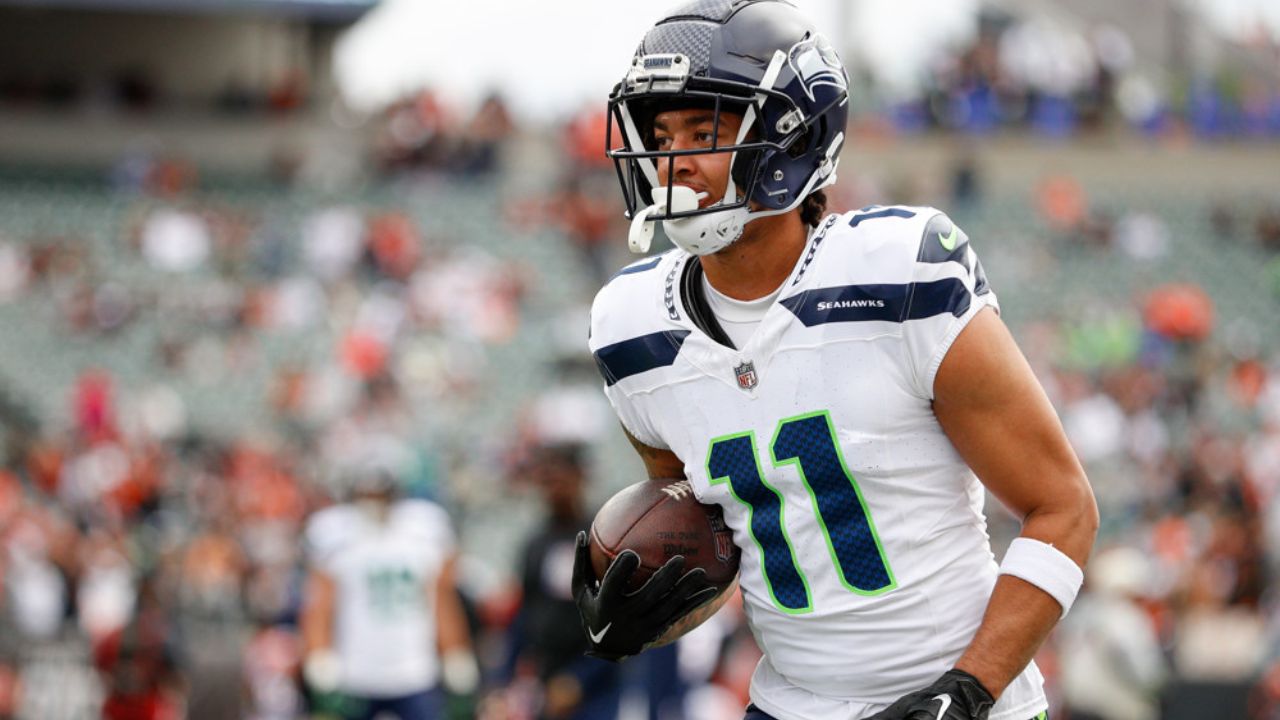
Seattle Seahawks 2026 Overview
Schedule
| Week 1 | vs. NE | Week 10 | at LV |
| Week 2 | at ARI | Week 11 | BYE |
| Week 3 | at WAS | Week 12 | at SF |
| Week 4 | vs. LAC | Week 13 | vs. DAL |
| Week 5 | vs. SF | Week 14 | vs. NYG |
| Week 6 | at DEN | Week 15 | at PHI |
| Week 7 | vs. KC | Week 16 | vs. LAR |
| Week 8 | vs. CHI | Week 17 | at CAR |
| Week 9 | vs. ARI | Week 18 | at LAR |
Wins
2025
14
2026 Over/Under
10.5
Play Calling
| 2025 | 2026 Projections | |
| Plays Per Game | 59.7 |
60.9 |
| Pass Rate | 50.0% | 51.9% |
| Run Rate | 50.0% | 48.1% |
Key Additions
- RB Jadarian Price
Key Departures
- Kenneth Walker III
Notable Coaching Changes
- OC Klint Kubiak Out
- OC Brian Fleury In
Sam Darnold
2025 Role & Results
The Big-Play TDs Hid the Volatility
Darnold was one of only 11 QBs to start all 17 games last season, and that durability drove his QB13 finish. His production was solid, not spectacular.
- 4,048 passing yards (fifth)
- 25 TDs (tied for ninth)
- 2.5% INT rate (29th)
Even in a low-volume attack, Darnold ranked eighth at 228.1 passing yards per game. Seattle finished 29th in attempts, 24th in neutral pass rate, and second in net yards per attempt (7.6).
Seattle built its offense around the run and downfield play-action shots, and Darnold ranked eighth with 134 play-action attempts.
The formula worked for Seattle, but it did not make Darnold a reliable weekly fantasy option. He posted QB1 numbers just six times and finished outside the top 20 in eight of his 17 starts.
Eight of Darnold’s 25 TD passes came from 20+ yards out, tied for eighth-most in the league. That big-play ability kept him on the weekly streaming radar, even if he was volatile week to week.
Fewer Attempts, Same Deep-Ball Bite
Seattle's run-first offense cut Darnold from 545 pass attempts in 2024 (eighth) to 477 in 2025 (15th). The lower volume cost him passing yards and TDs, but he still pushed the ball downfield effectively.
On passes of 20+ yards, Darnold ranked:
- first in completion rate (58.8%)
- third in PFF passing grade (97.6)
- fourth in passing yards (1,017)
The Scheme Changed His Ceiling
Among 29 QBs with 300+ dropbacks, Darnold ranked:
- second in yards per attempt (8.5)
- seventh in completion rate (67.7%)
- seventh in PFF passing grade (80.2)
Darnold added efficiency in Seattle but lost volume, which chipped away at his passing totals. Seattle's 26th-ranked pace and 23rd-ranked neutral pass rate explain much of the dropoff.
OC Klint Kubiak built that offense before leaving for the Raiders' HC job, and Mike Macdonald replaced him with Brian Fleury, who hails from the same San Francisco offense in which Kubiak served as 2023 pass-game coordinator. (Kubiak spent 2024 as Saints OC before his year in Seattle.)
Seattle’s Run Game Stole the TDs
Last year’s Seahawks ranked third in rushing attempts (507), ninth in rushing TDs (19), and 31st in red-zone pass rate, all of which cut into Darnold’s TD chances.
Having Jaxon Smith-Njigba helped the QB take advantage of the opportunities he did get, though. JSN led the NFL with a 33.9% target share, averaged a strong 15.1 yards per catch and caught 10 of Darnold’s 25 scoring tosses.
Availability Keeps Him in QB2 Mix
Darnold played all 17 games each of the past two years, one of only six QBs to do so.
That durability matters more in superflex than 1-QB. A healthy QB2 who plays every week has real value.
His last major injury was a high-ankle sprain in the 2022 preseason that kept him on IR until November.
2026 Opportunity & Projection
Shaheed Brings Splash Plays. Kupp Brings Questions.
Seattle returns its pass-catching group.
Smith-Njigba led the league with 1,793 receiving yards and ranked third with 119 grabs, but the depth behind him remains thin.
The Seahawks re-signed WR Rashid Shaheed to a three-year deal after acquiring him in November. He drew just a 10% target share, but his team-leading 15.8-yard average depth of target fits Darnold's deep-ball success from 2025.
After Shaheed arrived, Cooper Kupp ranked second on the team with a 16% target share, down slightly from the 17% he accumulated in the first nine weeks.
Kupp has also missed at least one game in each of his last four seasons.
Seattle used two-TE personnel 29.9% of the time, the league's eighth-highest rate, but A.J. Barner was the only fantasy-relevant option. He led Seattle's TEs with a 15% target share and finished as TE14 across formats.
Seattle's offensive line allowed the sixth-fewest sacks (27) and improved from 25th in 2024 to 20th in PFF's pass-blocking grades. ESPN also ranked the Seahawks 12th in pass-block win rate and adjusted sack rate.
The line helped maintain Darnold’s efficiency.
New OC, Familiar Blueprint
Fleury replaces Kubiak as Seattle's OC after seven seasons in San Francisco. He coached 49ers TEs the past four seasons, adding run-game coordinator to his job title for 2025.
Those 49ers ranked:
- seventh in yards per game
- 10th in points per game
- 10th in rushing attempts
That aligns closely with Seattle’s 2025 offensive identity under Kubiak.
Fleury worked with Kubiak in San Francisco in 2023, when Darnold was the backup QB.
This will be Fleury’s first stint as an OC, but the offense should look similar after Macdonald cited continuity as a key factor in the hire.
The line and pass-catching group return, but Seattle's backfield will look different. First-rounder Jadarian Price replaces Kenneth Walker III, and Zach Charbonnet is expected to miss significant time after suffering a torn ACL in the divisional round of the playoffs.
The offensive approach should remain similar, but if Price doesn't acclimate quickly, Seattle could throw a bit more. That extra volume would keep Darnold in the QB2 conversation as long as the efficiency holds.
Draft Sharks Verdict:
As expected, Darnold’s numbers dipped in Seattle’s run-first offense, but he still proved 2024 wasn’t a fluke by topping 4,000 passing yards for the second straight seson and leading the Seahawks to a Super Bowl win. Darnold projects as a low-end QB2 with weekly streaming appeal.
Customize Darnold’s projection for your exact league settings inside the Draft War Room.
Jadarian Price
2025 Role & Results
252 Vacated Touches Open the Door
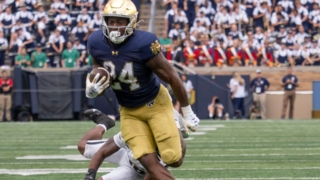
Price never handled a true workhorse role at Notre Dame, topping out at just 121 carries in a season while sharing the backfield with Jeremiyah Love. But the first-round pick finds a clear path to starting immediately in the pros.
Kenneth Walker III departed in free agency, vacating 252 regular-season touches.
Zach Charbonnet is rehabbing a torn ACL suffered in the divisional round of the playoffs and will miss a significant portion of the season. George Holani only logged 24 touches in the 2025 regular season, and Emanuel Wilson’s modest one-year deal suggests he’ll remain a complementary piece in Seattle.
That leaves Price as the overwhelming favorite to open the season as Seattle’s lead back in a scheme designed to generate chunk runs behind an O-line that ranked eighth in ESPN’s run-block win rate.
Explosive at Notre Dame; Untested as a Workhorse
Price maximized his limited opportunities in college, averaging 6.0 yards per carry and 10.8 yards per catch for his career and scoring 20 total TDs.
Among 165 FBS RBs with 100+ attempts last season, Price ranked:
- 15th in PFF elusive rating (118.6)
- 25th in yards after contact per attempt (3.92)
- 27th in yards per rush (6.0)
The concerns are straightforward: Price never topped 15 carries in a college game, caught only 15 passes in three seasons, and fumbled three times in 2025, all in short-yardage situations.
Seattle Already Built the RB Runway
Seattle remains one of the NFL’s most RB-friendly environments. Last season, the Seahawks ranked:
- third in rushing attempts
- third in points scored
- eighth in total offense
- sixth in yards per play
Even if there’s some regression from losing OC Klint Kubiak to the Raiders’ head job, this should remain a productive system that can support RB1 fantasy weeks. And the Charbonnet injury might clear Price to take advantage more than either Charbs or Walker could in 2025.
The Seahawks also ranked third in rushing TDs last season, giving Price immediate scoring upside if he secures goal-line work.
The O-line finished 11th in run-blocking grade (70.1) and eighth in ESPN’s run-block win rate.
Achilles' History Doesn't Look Like a Problem
Price ruptured his left Achilles’ tendon in June 2022 and missed his entire freshman season. But he returned in 2023 to average 5.8 yards per carry and then played all 28 games across 2024 and 2025.
At this point, the Achilles injury appears behind him. The bigger durability question now is whether Price can hold up under a much larger NFL workload after never handling feature-back volume in college.
2026 Opportunity & Projection
Walker’s Departure Sets Table for Price
Anyone who drafted Walker last season knows that although he led Seattle’s backfield in carries and targets, he shared a frustrating amount of work with Charbonnet.
Walker got 14.8 touches per game through the regular season, including a Week 3 contest Charbs missed. Charbonnet went down in the second quarter of Seattle’s playoff opener, though, clearing the way for Walker to average 24.7 touches across three postseason outings.
Charbonnet had his ACL repaired in February. The return timeline typically runs 9-12 months for that injury, so even the shortest end wouldn’t put the RB back on the field until sometime in November.
We can’t expect Price to absorb the entire combined workload of Walker and Charbonnet from last year. But he certainly has room to claim more of it than Walker ate as last year’s leader. And the Seahawks have indicated they’d like to keep the scheme similar to last year’s, which ranked 26th in the league in neutral-situation pass rate, according to RBSDM.com.
Fleury Inherits Kubiak's RB-Friendly Blueprint
Seattle quickly turned to Brian Fleury after OC Klint Kubiak left for Las Vegas. Fleury spent the past seven years in San Francisco, finishing as TEs coach and run-game coordinator in 2025. That span included working with Kubiak (then pass-game coordinator) in 2023.
HC Mike Macdonald prioritized continuity when making the hire, suggesting Seattle’s offensive identity will remain intact.
That should benefit Price. Our Price profile noted his decisiveness, open-field vision, and ability to reach top speed quickly when given a crease. That skill set should fit a Seattle run game built around defined lanes and efficiency, even if his limited college workload adds projection risk.
If Seattle maintains its run-heavy approach, Price should be a good bet for RB2 production.
Little Competition, Better Blocking, Clearer Runway
Price will run behind an O-line that leaped from 29th in ESPN’s run-block win rate in 2024 to eighth last season. That group returns intact and should remain a strength.
Charbonnet’s expected absence into the regular season leaves Emanuel Wilson and George Holani competing for roles. Wilson played well in fill-in duty for Green Bay at times over the past two years, but he signed for just $1.6 million on a one-year deal this offseason even before Seattle drafted Price. That doesn’t signal big plans for his usage.
Holani’s heading into his third season with the Seahawks but totaled just 25 carries and 3 targets over his first two.
Paths to Ceiling
If Price proves capable in the passing game and Seattle’s ancillary backs fail to carve out meaningful roles, he could claim a feature-level workload.
If the rookie proves capable of handling that much weekly work and the Seahawks remain efficient on offense, Price’s ceiling could flirt with RB1 territory.
Risk Factors
Price’s limited receiving production and light college workload add volatility. It’s possible that the Seahawks decide they need Wilson and Holani -- or perhaps another RB not currently on the roster -- to take a Charbonnet-level share of the work.
It’s also possible that Price opens the year as a workhorse and wears down quickly, which could either mean losing efficiency or getting hurt. There’s simply not much history on which to judge his durability.
Draft Sharks Verdict:
Price’s small college workloads and especially limited receiving add risk to his rookie-year fantasy outlook. But Zach Charbonnet’s ACL recovery boosts the workload ceiling. As long as Price remains outside the position’s top 20 in ADP, he’ll carry enough upside to be worth a shot. The further he slides beyond that top-20 range, the more attractive the Seattle RB gets.
Customize Price’s projection for your exact league settings inside the Draft War Room.
Zach Charbonnet
2025 Role & Results
Charbonnet Splits Work, Hogs TDs
Kenneth Walker III led Seattle in carries, RB targets, and yards from scrimmage last year. But Charbonnet stayed close and led the goal-line work. He logged:
- 184 carries to Walker’s 221
- 48 first downs to Walker’s 46
- 12 rushing TDs to Walker’s 5
Charbonnet’s short-yardage role drove his fantasy value, helping him match Walker at 11.2 PPR points per game in the regular season despite trailing in touches.
Walker finished the season as RB22 in PPR leagues, with Charbonnet at RB25.
He Owned the Valuable Work
Charbonnet dominated the valuable touches.
He handled 71% of Seattle’s short-yardage snaps, 84% of the 2-minute offense, and doubled Walker in carries inside the opponent’s 10-yard line (22 to 11).
Charbonnet finished six weeks inside the top 24, including three among the top 8. He ended another six weeks outside the top 30.
Goal-Line Volume Was Baked In
Seattle’s offense leaned run under OC Klint Kubiak in 2025 after ranking seventh in pass attempts the year before (under OC Ryan Grubb). Last year’s Seahawks finished third in rushing attempts, fifth in red-zone TD rate, and 31st in red-zone pass rate.
That shift benefited Charbonnet, creating more scoring chances for RBs near the goal line. And Charbonnet dominated those opportunities. He claimed 64.6% of Seattle’s rushing attempts inside the 10-yard line and 64.0% inside the 5. Walker drew just 20.8% inside the 10 and 28.0% inside the 5.
Charbonnet tallied 10 of his 12 rushing scores from inside the 10-yard line and 11 from inside the red zone.
The offensive line helped, leaping from 29th in ESPN’s run-block win rate in 2024 to eighth last season. That group returns intact and should remain a strength.
But Charbonnet’s knee injury alters last year’s two-back approach.
He Was Durable Until January
Charbonnet tore his left ACL in the playoff win over San Francisco. He had surgery in February, an operation that typically carries a 9-12 month recovery timeline. That almost certainly means Charbonnet will open the coming season on the physically unable to perform list.
2026 Opportunity & Projections
His Competition Changed During Rehab
The knee injury is Charbonnet’s biggest obstacle. Once he returns, he’ll find first-round rookie Jadarian Price in place of Kenneth Walker III, who signed with the Chiefs in free agency.
Price never exceeded 120 carries in a college season while sharing the Notre Dame backfield with Jeremiyah Love. Price also caught just 15 passes across his three years there. So we can’t know how he’ll hold up to -- or perform in -- a larger NFL workload. But drafting him at the end of Round 1 suggests the Seahawks expect plenty from him.
The rookie averaged 6.0 yards per carry and 10.8 yards per catch while tallying 20 total TDs across his limited college workloads.
Before drafting Price, Seattle signed former Packers RB Emauel Wilson to a one-year, $1.6 million deal to join George Holani. They’ll compete for complementary and/or backup roles and would likely cede work to a fully healthy Charbonnet.
Better Blocking Helps the Whole Group
Outside of the backfield, the Seahawks’ offense looks basically the same. That includes an O-line that ranked 12th in ESPN’s pass-block win rate and eighth in run-block win rate last season.
If Price struggles to adapt to the NFL or wears down under the unfamiliar workload pressures, then Charbonnet could see meaningful late-season work … if he gets back near full strength.
The risk, obviously, is that the repaired knee never allows him to reach that level in 2026.
Draft Sharks Verdict:
If you’re drafting right now, then Charbonnet shouldn’t enter your consideration until the very late rounds. Even in a best ball format with playoff weeks such as Underdog Fantasy’s most common setup, Charbs presents as much risk as upside from his current ADP early in Round 14. We’ll see about his outlook for non-best ball drafts as the season draws closer and we know more about his recovery.
Customize Charbonnet’s projection for your exact league settings inside the Draft War Room.
Jaxon Smith-Njigba
2025 Role & Results
WR2 in a Low-Volume Offense
Smith-Njigba exploded in his third NFL season, finishing with:
- 163 targets (fourth in the league)
- 119 catches (third)
- 1,793 receiving yards (first)
- 10 TDs (tied for fourth)
He finished as the overall WR2 in both PPR points per game and total PPR points, despite running 5.7 fewer routes per game than he did in 2024, per Fantasy Points Data.
Smith-Njigba delivered strong week-to-week consistency, posting 12 WR1 finishes and only one finish outside the top 36.
Outside More, Featured Everywhere
Smith-Njigba became the clear focal point of Seattle’s passing attack in 2025. His 33.9% target share led the NFL and represented a jump from the previous season’s 24%.
Seattle moved him all over the formation:
- 23.9% slot rate
- 73.6% perimeter snaps
- 18 snaps in the backfield
That marked a stark shift from his slot shares of 69.0% in 2024 and 83.6% in 2025.
JSN also saw his opportunities move further down the field. His average depth of target climbed for the second straight year, from 9.2 to 11.7 after he hit 6.4 as a 2023 rookie. Smith-Njigba saw no real loss in catch rate (75.2% in 2024 vs. 74.7% in 2025) while boosting his:
- Yards per catch (11.3 to 14.6)
- Yards per route (1.81 to 3.42)
- And TD rate (6.0% to 8.4%)
Seattle schemed him touches in every situation, allowing JSN to lead the team in:
- red-zone targets
- third-down targets
- targets per route run
His role increasingly resembled the type of volume-heavy deployment reserved for true alpha WRs.
The Metcalf Trade Unlocked the Outside Game
Smith-Njigba’s production is even more impressive considering it came in an offense that ranked 30th in pass rate.
Among qualifying WRs with 35+ targets, he ranked:
- first in ESPN’s open rate (86%)
- second in yards per route run (3.42)
- second in PFF receiver grade (93.2)
- second in fantasy points over expected per game (3.9)
- fourth in yards after catch (596)
Being featured outside was a huge catalyst for Smith-Njigba’s breakout. He ran just 15.6% of his routes from the perimeter in 2024, before Seattle traded outside leader DK Metcalf to Pittsburgh.
Passing Volume Shrunk While His Role Grew
Seattle ran the ball a lot more under OC Klint Kubiak in 2025. The Seahawks ranked:
- third in rushing attempts
- 23rd in neutral pass rate
- 26th in pace of play
That lower-volume environment capped overall passing production, but JSN overcame it by dominating targets and delivering special efficiency.
Sam Darnold also proved to be a good fit for JSN’s skill set. Darnold ranked seventh in completion rate and second in yards per attempt.
He Hasn't Missed an NFL Game
Smith-Njigba has played all 17 regular-season games in each of his three seasons. He also played all three of Seattle’s postseason contests in 2025.
Smith-Njigba has no injury history in the NFL but had a severe hamstring injury in 2022 that cost him 10 games at Ohio State.
He also fractured a bone in his left wrist in the 2023 preseason and required surgery but was able to play in Week 1.
2026 Opportunity & Projections
Target Supremacy Is Safe
JSN enters 2026 as Seattle’s undisputed No. 1 WR and will remain one of the most heavily targeted WRs in the league.
The Seahawks return Rashid Shaheed, Cooper Kupp, and TE A.J. Barner, but none project as true challengers for target supremacy.
Shaheed profiles more as a field stretcher, while Kupp enters his age-33 season coming off another injury-marred campaign.
Seattle's Backfield Questions Point Back to JSN
Seattle returns most of last year’s offensive core.
Sam Darnold is back after throwing topping 4,000 passing yards for the second straight season and leading Seattle to a Super Bowl title. The offensive line also improved significantly last season, finishing:
- 12th in pass-block win rate
- eighth in run-block win rate
The biggest concern is overall passing volume. Seattle still wants to lead with rushing and defense under HC Mike Macdonald. That offensive plan might have to shift some, though, if a backfield missing Zach Charbonnet and led by rookie Jadarian Price doesn’t match last year’s effectiveness.
Seattle’s also unlikely to match last year’s combo of the third-best scoring offense and No. 1 scoring defense, simply because that’s difficult to accomplish perennially. Trailing in even just a few more games could increase team passing volume.
Continuity Favors the Target Hog
Brian Fleury replaces Kubiak as Seattle's OC after seven seasons in San Francisco. He spent the last four as TEs coach, adding run-game coordinator to his job title for 2025.
Last season, San Francisco ranked:
- 10th in rushing attempts
- 24th in rushing yards
- 11th in neutral pass rate
Fleury worked with Kubiak in San Francisco in 2023, when Darnold was the backup QB.
This will be Fleury's first stint as an OC, but the offense should look similar. Macdonald indicated continuity as a key factor in Fleury's hiring.
Fleury also comes directly from Kyle Shanahan’s system, where San Francisco consistently leaned on play action, motion, heavy personnel, and an efficient run game, all staples of Seattle’s offense in 2025. That background suggests the Seahawks will continue leaning run.
The line and pass-catching group return, but Seattle's backfield will look different. First-rounder Jadarian Price replaces Kenneth Walker III, and Zach Charbonnet is expected to miss significant time after suffering a torn ACL in the divisional round.
The offensive approach should remain similar, but if Price doesn't acclimate quickly, Seattle could lean more on the passing game.
Paths to Ceiling
If Seattle’s pass volume climbs even slightly, Smith-Njigba has overall WR1 upside. His league-leading target share and versatility already give him one of the safest workloads in fantasy football.
A decline from the rushing attack would only funnel more volume toward Smith-Njigba.
Risk Factors
A first-time play caller adds risk to the offense. We saw in Philadelphia last year how lackluster offensive planning and execution can drag down a talented offensive group. (Although there were more factors at play in Philly than the since-fired OC.)
Smith-Njigba and his QB could also simply see their efficiency decline from last year’s high levels. Those would have to come way down to knock JSN out of WR1 territory, but declines in catch and yardage efficiency could easily turn the young wideout into a slight disappointment vs. his early-to-mid Round 1 ADP.
Draft Sharks Verdict:
Smith-Njigba should be viewed as a high-floor WR1. He already proved he can deliver elite production in a low-volume pass offense. JSN combines youth, durability, and a locked-in target share. That makes him one of the safer Round 1 WR picks.
Customize Smith-Njigba’s projection for your exact league settings inside the Draft War Room.
Rashid Shaheed
2025 Role & Results
His Best Season Came in Two Parts
Shaheed had his best fantasy performance last season, but the majority of that production came in Weeks 1-9 with New Orleans. Here were his numbers with the Saints:
- 7.3 targets per game
- 4.9 receptions per game
- 55.4 receiving yards per game
- 21% target share (second on team)
- 30.3% air-yards share (second)
Shaheed ranked 26th among WRs in PPR scoring through Week 9, but his production would crater after the trade to Seattle:
- 2.9 targets per game
- 1.7 receptions per game
- 20.9 receiving yards per game
- 10% target share
Shaheed reached WR27 in two of his nine regular-season appearances for Seattle. The other seven found him outside the position’s top 60, however.
The Saints led the league in pace of play and ranked fifth in passing rate over expected, while Seattle ranked 26th in play pace and 30th in pass rate over expected. So Shaheed’s regression was unwelcome, but not shocking.
The Role Got Smaller Fast
Shaheed averaged a 74% snap share and 80.3% route rate in New Orleans but fell off to a 48% snap share and 61.9% route rate in Seattle.
Cooper Kupp stayed on the field for 77% of the Seahawks snaps after Shaheed’s arrival.
The Seahawks used three WRs on just 41.4% of their snaps, fourth-lowest in the league, which limited Shaheed's opportunities and left him in a part-time role.
Seattle Bought More Than a Midseason Rotator
Shaheed averaged 55.4 receiving yards and 11.6 PPR points per game with the Saints, then dipped to 20.9 yards and 5.8 PPR points per game with the Seahawks.
The drop-off closely mirrored his declining snap share and route participation after the trade.
The encouraging sign came after the season, when the Seahawks re-signed him for $51 million over three years. Shaheed’s new contract suggests the team envisions a significantly larger offensive role going forward.
Explosive Fit, Thin Usage
Seattle transitioned into a run-favoring offense under OC Klint Kubiak in 2025. The Seahawks ranked:
- third in rushing attempts
- 23rd in neutral pass rate
- 26th in pace of play
That run-first approach limited overall passing volume and helped cap Shaheed’s weekly consistency after the trade.
But Seattle’s offensive structure fit his vertical skill set. Sam Darnold tied for third in the league last year with 4.8 completed air yards per pass attempt, according to Pro Football Reference. That signaled Darnold not only keeping his average target depth up (10th among 38 QBs with 200+ dropbacks) but also supplying career-best efficiency (67.7% completions and 8.5 yards per attempt).
Darnold specifically ranked second in the league in deep-ball completion rate, connecting on 52.3% of his throws 20+ yards downfield, according to PFF.
That area could align well with Shaheed’s speed going forward.
Healthy in 2025, Not Clean Overall
Shaheed avoided injuries last season, playing in all 18 weeks. However, he did suffer a concussion in Week 17.
The biggest injury on his resume is a torn meniscus from 2024 that cost him the final 11 games of the season.
In 2023, a Week 12 thigh injury cost him two games.
2026 Opportunity & Projections
Seattle Paid Like He Matters Now
The Seahawks gave up fourth- and fifth-round picks in the 2026 draft for Shaheed and then re-signed him at $17 million per year. That commitment by the team indicates a larger role in the offense, which Shaheed hinted at:
“I’m super excited to get a full offseason with this team, with these coaches,” Shaheed said. “It’s exciting that I get to be around these guys for a longer period of time and build off of what we built last year, and for my role to continue to grow.”
Combine all that with Kupp coming off a career-worst 1.40 yards per route run and 7.4 PPR points per game and heading into his age-33 season, and it’s pretty easy to bet on Shaheed claiming the No. 2 WR role this season.
He Still Fits What Darnold Does Best
Brian Fleury replaces Kubiak as Seattle's OC after seven seasons in San Francisco. He spent the last four as TEs coach, adding run-game coordinator to his job title for 2025.
Last season, San Francisco ranked:
- 10th in rushing attempts
- 24th in rushing yards
- 11th in neutral pass rate
Fleury worked with Kubiak in San Francisco in 2023, when Darnold was the backup QB.
This will be Fleury's first stint as an OC, but the offense should look similar after Macdonald indicated continuity was a key factor in Fleury's hiring.
Fleury also comes directly from Kyle Shanahan’s system, where San Francisco consistently leaned on play-action, motion, heavy personnel, and an efficient run game, all staples of Seattle’s offense in 2025. That background suggests the Seahawks will continue leaning run while targeting explosive pass plays.
Paths to Ceiling
Shaheed’s 2026 upside will prove limited if everyone stays healthy and the run-pass split mirrors last year’s offense. Obviously, a JSN injury would present the biggest boost in opportunity.
Short of that, we could see some more passing volume if Seattle trails more often in games than last year’s Super Bowl-winning squad. That split could also lean more pass if a backfield now relying heavily on rookie Jadarian Price struggles to produce.
As long as Smith-Njigba’s on the field, though, Shaheed will need to prove he can provide starter-level value in typical fantasy formats before we’re trusting him in lineups.
Risk Factors
Seattle’s run-heavy offensive philosophy could continue to limit overall target volume.
Shaheed also remains somewhat dependent on splash plays, making him a volatile option week-to-week, and he has missed multiple games due to injuries in his first three seasons.
Draft Sharks Verdict:
Shaheed’s new contract confirms Seattle views him as a core piece opposite Jaxon Smith-Njigba. His weekly volume will remain volatile in a run-heavy offense, though, which is likely to keep him in weekly boom-bust territory. Shaheed fits much better as a later-round best ball option than on your redraft roster.
Customize Shaheed’s projection for your exact league settings inside the Draft War Room.
Cooper Kupp
2025 Role & Results
Eleven Weeks Outside the Top 36
Kupp’s first season in Seattle failed to reignite his fantasy value. He finished with:
- 70 targets
- 47 catches
- 593 receiving yards
- 2 TDs
Kupp averaged a career-low 7.4 PPR points per game and finished outside the top 36 WRs in 11 of his 16 weeks.
Kupp’s production became even shakier after Seattle traded for Rashid Shaheed at midseason. He went from 3.4 catches and 41.9 yards per game before Shaheed arrived to 2.6 and 33.3 after. He failed to reach 50 receiving yards in his final eight regular-season outings after doing so three times over the first half.
Kupp did rebound, at least, for these lines in the three playoff games:
- 5-60
- 4-36-1
- 6-61
Moving to Seattle Hurt; Shaheed’s Arrival Didn’t
Frankly, we figured Rashid Shaheed’s midseason arrival would kill Cooper Kupp’s season. But it didn’t for a couple of reasons.
- Kupp’s playing time remained intact after the trade. He went from running a route on 78.5% of dropbacks before the trade to 77.2% after.
- Kupp’s fantasy value died long before Shaheed arrived.
His 14.9% target share for the season ranked just 59th among WRs. That number sat at just 15.8% through Week 9, before Shaheed’s arrival, ranking 58th.
And those shares look even worse when you put them on a team that ranked 29th in total pass attempts in 2025.
Kupp didn’t help himself by posting a career-low 1.49 yards per route while spending less time in the slot (47%, according to PFF) than he did in any other season.
The Curve Has Been Pointing Down
Kupp’s production has steadily declined since his historic 2021 season.
| Year | Games | Catches | Yards | TD | Yds/Route | PPG Rk |
| 2021 | 17 | 145 | 1947 | 16 | 3.12 | 1 |
| 2022 | 9 | 75 | 812 | 6 | 2.40 | 1 |
| 2023 | 12 | 59 | 737 | 5 | 1.86 | 29 |
| 2024 | 12 | 67 | 710 | 6 | 1.90 | 27 |
| 2025 | 16 | 47 | 593 | 2 | 1.40 | T-74 |
Kupp also turns 33 in June and comes with durability concerns.
Durability Isn’t a Side Note at 33
Kupp has missed games in four consecutive seasons. Last year found him dealing with heel and hamstring issues but missing just one game.
A Week 2 high-ankle sprain cost him four games the previous season. An August 2023 hamstring injury forced him to miss the first four games, and a high-ankle sprain ended his 2022 after nine games, requiring surgery.
A 2018 torn ACL cost Kupp the final six games of that campaign, but he rebounded with a strong showing in 2019.
The long list of lower-body injuries is impossible to ignore, especially as Kupp heads into his age-33 season.
2026 Opportunity & Projections
Role Is Shrinking With the Skills
Seattle returns most of its offensive core. Rashid Shaheed is expected to emerge as Seattle’s No. 2 after garnering a three-year, $51 million deal in free agency. Any role growth there would reduce Kupp’s playing time and target allotment.
JSN remains the engine of the passing game after leading the NFL in receiving yards last season.
Second-year WR Tory Horton and sixth-round rookie Emmanuel Henderson add depth. Horton played 46% of Seattle’s snaps and had three top-36 finishes on a 10% target share before injuring his shin in Week 9 and missing the remainder of the season.
The Seahawks also project to remain heavily committed to the run behind first-round RB Jadarian Price.
That creates a difficult environment for Kupp to return meaningful fantasy value.
Paths to Ceiling
Kupp landed outside the top 50 fantasy WRs across formats last year, despite arriving on a $15 million-a-year contract to a pass offense with JSN and not much else. It’s tough to see a path to meaningful upside this year unless multiple WR teammates go down.
Risk Factors
Kupp looks like a ball of risk factors. His opportunity and production fell off last season, and then Seattle paid up to keep a younger, faster wideout off the open market. It’ll be really surprising if Kupp stays ahead of Shaheed in playing time.
Add to that a pass offense that looks like it wants to stay low-volume, plus a lengthy, recent injury history and his age-33 season.
Kupp makes the downside case for himself.
Draft Sharks Verdict:
Kupp landed in WR5 territory in his first Seattle season and cracked the weekly top 24 just three times in PPR. His 2026 environment looks even worse, and he heads into his age-33 campaign. Leave Kupp for someone else.
“Customize Kupp’s projection for your exact league settings inside the Draft War Room.”
A.J. Barner
2025 Role & Results
Six TDs Carried the Fantasy Line
Barner took a sizable leap in his second NFL season, finishing with career-best marks across the board:
- 68 targets
- 52 catches
- 519 receiving yards
- 6 TDs
He finished as the TE14 in PPR scoring and became Seattle’s lead TE on a 78% snap share. Compare that with his rookie-year numbers:
- 38 targets
- 30 catches
- 245 yards
- 4 TDs
- 45.5% snap share
Barner benefited from spike weeks, primarily powered by those TDs. He posted six top-12 finishes but closed just one other week higher than 20th (TE17 in Week 6). Seven other weeks found Barner ranking 27th or worse.
That’s how it goes when you exceed 3 receptions on just four occasions, with a mere two of those climbing past 4 catches. One of Barner’s top-12 weeks even required a 1-yard rushing TD.
The TD Dependence Is Hard to Ignore
TD points accounted for 24.4% of Barner’s PPR total. That ranked 12th-highest among the top 50 scorers at the position. Among the top 20 fantasy TEs, only four leaned more heavily on TD points.
Barner also had to block on 16.8% of his pass snaps. That ranked fifth-highest among 49 TEs who drew at least 30 targets last season. That’s especially damaging to a guy already playing in a low-volume pass offense (29th in pass attempts).
Run-Heavy Didn’t Kill the Role
Seattle transitioned into a run-leaning offense under OC Klint Kubiak in 2025. The Seahawks ranked:
- third in rushing attempts
- 23rd in neutral pass rate
- 26th in pace of play
Seattle used two-TE personnel on 29.9% of offensive snaps last season, the league’s eighth-highest rate. But Barner was the only fantasy-relevant TE. He led the group with a 13.3% target share.
Rookie Elijah Arroyo played the second most snaps at the position, living in the range of 37% to 47% playing time through Week 13 before a knee injury ended his regular season in Week 14.
Through Week 13, Arroyo ran 153 pass routes to Barner’s 235 and drew 25 targets to Barner’s 46.
The Health Profile Is Quietly Clean
Barner has played in all 37 of his career games, including last year’s playoff run. He was also durable in college, missing just two games in 2022 at Indiana with a foot injury before playing all 15 games at Michigan in 2023.
2026 Opportunity & Projections
Barner Should Lead … But There’s a Challenger
The Seahawks lost OC Klint Kubiak to the Las Vegas head job. They replaced him with Brian Fleury, who spent the past seven years in San Francisco under Kyle Shanahan. That included working with Kubiak on the 2023 offensive staff.
Seattle has indicated that scheme continuity played a key role in Fleury’s hiring, so we should expect plenty more running and two-TE sets. But does that mean we should assume the same role and usage for Barner?
The 24-year-old certainly enters the year as the favorite to lead Seahawks TEs in playing time and targets once again. But he could easily cede some receiving work to Arroyo.
Second-Year Teammate Could be a Problem
Here’s what HC Mike Macdonald said about Arroyo after the team drafted him last April: “Elijah Arroyo can run an extensive route tree. He can split out wide and do ‘X’ receiver-type things. Bigger body, provides a ton of value. And then he’s gonna go in there as an actual inline TE and create some of those bigger personnel formations. That’s the vision we have for him.”
GM John Schneider added, “If he didn’t miss time [because of a college ACL tear], his talent is like a top 15 pick. This guy is special.”
That sure sounds like a player the Seahawks would like to involve more. And although Arroyo can move around the formation, any increase in playing time for him would likely impact Barner’s at least a bit.
Paths To Ceiling
The best case for Barner is that he holds off Arroyo for the position’s clear lead in playing time and opportunities. He’s not likely to see a target spike, though, without an injury to WR Jaxon Smith-Njigba. Seattle also re-signed WR Rashid Shaheed for $17 million a year this offseason.
The team could also be forced to pass a good bit more this season. The backfield lost Kenneth Walker III gone, and Zach Charbonnet’s working back from February ACL surgery. Last year’s combo of ranking third in scoring and first in fewest points allowed will also be difficult to repeat, thus giving way to potentially more trailing game scripts.
Still, those extra targets would likely spread around more than generate a volume spike for even the No. 1 TE. Barner looks like a continued TD-or-bust bet, which can deliver big weeks but also prove hard to trust in weekly fantasy lineups. He’s best suited for non-PPR use.
Risk Factors
Arroyo’s potential ascension is the biggest risk, beyond the low-volume issues Barner already dealt with last year. A larger role for Shaheed could also leave a smaller target share for Seattle TEs overall.
The position could also siphon some share from the depleted backfield, though, especially when you consider the limited college receiving experience for first-round RB Jadarian Price (15 career catches).
Draft Sharks Verdict:
Barner’s fantasy ascension in 2025 relied heavily on TDs, and he looks likely to remain the same kind of asset. Add a potential role challenge from second-year TE Elijah Arroyo, and Barner looks like a guy better left to someone else in your draft.
Customize Barner’s projection for your exact league settings inside the Draft War Room.
Draft Sharks Verdict:
Barner’s fantasy ascension in 2025 relied heavily on TDs, and he looks likely to remain the same kind of asset. Add a potential role challenge from second-year TE Elijah Arroyo, and Barner looks like a guy better left to someone else in your draft.
Customize Barner’s projection for your exact league settings inside the Draft War Room.




Draft using the best dynamic tool in the industry. Our fantasy player valuations (3D Values) change during your draft in response to...
- Exact league settings - direct sync
- Opponent and Team Needs
- Positional scarcity & available players
- Ceiling, injury risk, ADP, and more!
You need a dynamic cheat sheet that easily live-syncs with your draft board and adapts throughout your draft using 17 crucial indicators.
Get your Draft War Room Today