Aging, Altered 49ers Present Sneaky Fantasy Upside
Team Details
San Francisco 49ers 2026 Overview
Schedule
| Week 1 | at LAR | Week 10 | at DAL |
| Week 2 | vs. MIA | Week 11 | vs. MIN |
| Week 3 | vs. ARI | Week 12 | vs. SEA |
| Week 4 | vs. DEN | Week 13 | at NYG |
| Week 5 | at SEA | Week 14 | vs. LAR |
| Week 6 | vs. WAS | Week 15 | at LAC |
| Week 7 | at ATL | Week 16 | at KC |
| Week 8 | BYE | Week 17 | vs. PHI |
| Week 9 | vs. LV | Week 18 | at ARI |
Wins
2025
12
2026 Over/Under
10.5
Play Calling
| 2025 | 2026 Projections | |
| Plays Per Game | 63.6 | 61.6 |
| Pass Rate | 55.5% | 55.5% |
| Run Rate | 44.5% | 44.5% |
Key Additions
- WR Mike Evans
- WR De'Zhaun Stribling
- WR Christian Kirk
- RB Kaelon Black
Key Departures
Brock Purdy
2025: QB Showed Usual Accuracy … When He Could Play
Purdy’s 2025 story has to start with the turf toe that significantly disrupted his availability and probably impacted his play at times when he was on the field.
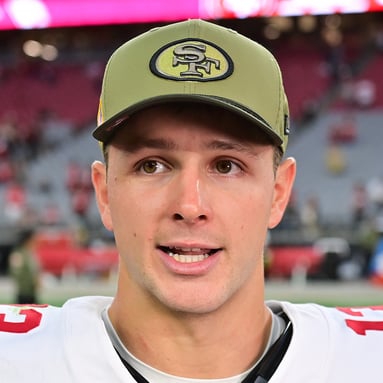
The QB suffered the initial injury in Week 1 and missed the next two contests. He returned for a Week 4 loss to the Jaguars, completed an uncharacteristic 57.9% of his passes (Purdy typically ranks among the most accurate passers), and flung 2 INTs. Purdy also aggravated the toe in that game and missed the next six weeks.
He returned for Week 11 and managed to stay on the field from there. Despite a Week 12 stinker against Carolina (193 yards and 3 INTs), Purdy also looked more like what we’ve come to expect over those final seven games:
- 70.6% completions
- 225.9 yards per game
- 2.3 passing TDs per game
- 0.9 INTs per game
- Solid 26-117-3 rushing line (4.5 yards per carry; 16.7 yards per game)
Purdy’s numbers stunk in the playoffs, but he faced a challenging Eagles defense in Round 1 and a championship Seahawks D in the lopsided Round 2 loss. His pass-catching corps also didn’t look very good by that point, but we’ll get to that a little later.
Missed Time Didn’t Cut Into His Effectiveness
For the season, Purdy actually delivered a career high in fantasy points per game (depending on your format) and ranked fifth at the position in that category. His nine appearances revealed some inconsistency … but also potential reason for optimism.
Purdy posted a QB14 finish in the opener and a QB12 finish in Week 4. He landed seventh among QB scorers in his Week 11 return but followed that with QB22 and QB16 finishes.
After the Week 14 bye, the Niners pilot reeled off consecutive finishes of QB3, QB1, and QB1 before a QB28 whimper against Seattle in the regular-season finale.
Matchups didn’t hurt in the late-season peak weeks, which came against Tennessee, Indy, and Chicago. They ranked 29th, 15th, and 25th in pass DVOA for the season, respectively.
High-End Efficiency Drives His Value
Purdy matched his career high for the season with a 69.4% completion rate, which also ranked third in the league among qualifiers. The only two guys ahead of him? Drake Maye and Purdy’s own backup, Mac Jones.
That speaks to the consistent efficiency of the Kyle Shanahan Niners offense, which has previously generated high-end rate stats for mediocre (or worse) QBs such as Jimmy Garoppolo, Nick Mullens, and C.J. Beathard.
Purdy also hit 7.0% in passing-TD rate for the third time among his four pro seasons. How good is that? Lamar Jackson currently leads active QBs with a 6.5% career rate. Purdy’s second at 6.2%, with Aaron Rodgers (6.0%) the only other guy at 6+%.
Purdy also edged his personal best in passing success rate, a Pro Football Reference stat that measures how often a player delivers the “needed” yardage in a given situation. Purdy has led the league in that category in two of his three years as the season-opening starter.
Since his 2022 debut, Purdy also ranks:
- sixth in completion rate
- second in TD rate
- second in passer rating
- first in yards per pass attempt
The sneakiest factor in Purdy’s scoring profile might be his rushing. He ranks 17th among all QBs in rushing yards per game over the past two seasons (minimum 50 total carries), and four of the guys ahead of him won’t be starting this year:
Only six QBs have run for more TDs over the past two years, despite Purdy ranking just 17th in total rushing attempts.
His carries per game dipped from 4.4 in 2024 to 3.7 last year, and his yards per rush from 4.9 to 4.5. That’s understandable for a QB dealing with turf toe. And even at full health, Purdy will likely never see much designed rushing work. He only has 10 such carries through his four-year career to date, according to Pro Football Focus.
But a healthy Purdy is a plus scrambler, and all eight of his rushing scores over the past two years have come from inside the 10-yard line; five of those from the 5 or closer.
That can be a volatile stat, but San Francisco’s consistently high-end offense should keep those scoring opportunities available.
Numbers Came Despite Lackluster Supporting Cast
Purdy’s strong efficiency numbers for 2025 look even better when you remember what he had around him.
Christian McCaffrey stayed healthy all year and will always help an offense. But he garnered 39 more targets than anyone else on the team. That short-range dynamo will help a QB’s completion rate, but a lack of non-RB assistance usually makes it tougher to maximize yardage and scoring.
WR Jauan Jennings drew the second-most targets last year, despite missing two games and playing through injuries in at least several others. TE George Kittle ranked third despite missing five full games (and most of the opener) with a hamstring tear plus another with a sprained ankle.
Behind them sat:
- 30-year-old WR Kendrick Bourne
- Nine games of WR Ricky Pearsall (knee injury)
- Backup TE Jake Tonges
- 31-year-old WR Demarcus Robinson
- FB Kyle Juszczyk
… and then a smattering of guys drawing 14 targets or fewer apiece.
That was a markedly worse pass-catching group than in Purdy’s previous three campaigns.
2026 Presents Reasons for Optimism
Purdy made it back from injury for the end of last season and continues to play for Shanahan. So the most important factor for his 2026 outlook seems like San Francisco’s offensive imports.
The Niners signed WR Mike Evans in free agency. You probably know the résumé, but here are a few highlights:
- More than 1,000 receiving yards for 11 straight seasons before last year
- 11+ TD catches in four of his past six seasons
- 10th-most career TD receptions in NFL history
- 4.9 receptions per game for his career
Evans notably missed a career-high nine games last season, thanks to a hamstring injury, clavicle fracture, and concussion. The hamstring issue is most troubling, because it has popped up in some form every year since 2019. But he missed just 12 total games across 11 seasons before last year. So we’re not gonna overrate that factor for Purdy’s purposes.
San Francisco also added WR Christian Kirk in free agency and drafted WR De’Zhaun Stribling at the top of Round 2. But Evans easily outweighs both in potential impact.
The Niners will miss Pearsall for the season, now that he needs surgery to address the knee injury lingering from last season. But they brought back Deebo Samuel to likely pair with Evans as the starting duo. And Stribling has impressed this summer.
Kittle’s status will be worth watching as well. He suffered an Achilles’ tear in the playoff win at Philadelphia. Reports on his recovery have been glowing vs. the severity of the injury, but we’ll have to watch to see both how soon he’s ready to play and how close he seems to full strength.
Anything close to a full-strength Kittle offers obvious help to a QB’s passing outlook.
Altogether, this year’s pass-catching crew looks at least better than what the 49ers typically ran out last year -- and potentially stronger than the 2024 version as well.
Shanahan Keeps Lifting the Floor
Shanahan’s offense probably doesn’t need a case built for it at this point. But just in case you’re wondering, his 49ers have ranked seventh or higher in six of the past seven seasons, including each of the past five.
Five straight Niners teams have ranked sixth or higher in net yards per pass attempt, which incorporates sacks, and five of Shanahan’s eight offenses have ranked third or higher in that category.
In short, this has been a consistently strong and efficient offense that regularly puts players in position to maximize their output potential.
High Floor Beats Ceiling Case with Purdy
Purdy took over as 49ers starter over the final third of his rookie season and opened 2023 as the guy. Over the past three seasons, he has generated the sixth-most fantasy points per game at the position. He finished those years seventh, ninth, and fifth in points per game.
The case for Purdy is more about floor than ceiling. His accuracy, mobility, and Shanahan’s system make him a strong bet to finish among the top 12 QBs, and he did it last year despite a lackluster supporting cast.
Barring injury, Purdy looks like as safe a bet as anyone in his range of QB ADP.
DraftSharks Verdict:
We know Purdy and the 49ers can generate points. We also know he’ll present some downside risk in tougher matchups. His draft price around the QB1-QB2 border makes Purdy one of the top values by our ADP Index. He’s a nice target as either your intentional late QB1 or a safety net at the position. Consider pairing Purdy with a platoon partner high in QB2 range to maximize your output at the position in 1-QB formats.
Customize his projection for your exact league settings inside the Draft War Room.
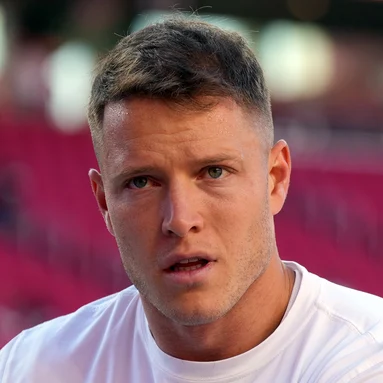
Christian McCaffrey
Healthy CMC Still Breaks Fantasy
You’ve probably heard that McCaffrey led all RBs in scoring last year -- 2.6 points per game ahead of his nearest PPR competitor (Bijan Robinson), depending on your format. So let’s refresh on his past few years …
- 2022: 17 games split between Carolina (six) and San Francisco (11); RB2 in PPR points per game (behind Austin Ekeler)
- 2023: 16 games with the 49ers; 3.3 points per game ahead of No. 2 (Kyren Williams), and another 3.4 PPG ahead of No. 3
- 2024: just four games, thanks to issues with both Achilles’ tendons; the fantasy world wept
- 2025: 17 games; loads of points.
McCaffrey has topped 100 targets two of his past three healthy seasons. The other one merely found him rushing for a career-high 5.4 yards per rush and setting career highs with 7 TD catches and 21 total TDs.
He matched that TD-catch high last season, drew the second-most targets of his career, cracked 9.0 yards per catch for the second straight season and third time in his career, and reached 300 carries in a season for the first time.
But There Might Be One Thing to Worry About
McCaffrey’s high-scoring, high-volume, healthy, 2025 made it easy to overlook a decline in rushing efficiency.
His 3.9 yards per rush marked his lowest average since a three-game 2020. It nearly matched the 4.0 of his four-game 2024, which we could have otherwise dismissed because of the calf issues.
McCaffrey also posted his lowest rush yards over expected per attempt since NFL Next Gen Stats started tracking. His minus-0.54 mark ranked fifth-worst among 51 qualifiers, ahead of only:
That marked a particularly steep drop from McCaffrey’s 1.34 of 2023. Pro Football Focus also credited him with his lowest rushing grade since his 2017 rookie season and the worst breakaway percentage (share of yards gained on designed runs that went 15+ yards) of his career. McCaffrey’s 16.7% in that category ranked 42nd among 51 RBs who carried at least 90 times last year. Here’s the crew that trailed him:
- Rachaad White
- Alvin Kamara
- Bucky Irving
- Michael Carter
- Devin Singletary
- Kareem Hunt
- Isiah Pacheco
- Emanuel Wilson
- Chuba Hubbard
Brian Robinson Jr. -- San Francisco’s No. 2 RB in 2025 -- sat one spot ahead of McCaffrey at 16.8%.
CMC tied for fourth-best in that category in 2023, at 34.5%.
To be fair, the cast surrounding McCaffrey probably helped his workload volume while hindering his efficiency. A struggling Niners pass-catching corps helped afford him the league’s highest RB target share (21.3%) on top of the league’s fourth-largest carry share (64.7%).
But McCaffrey’s yards before contact per attempt fell from a career-high 3.1 in 2023 to just 2.3 last season. That ranked 25th among qualifiers and below the league average of 2.5. McCaffrey’s endured just two lower marks among his eight seasons, and they came in a three-game 2020 and seven-game 2021, both with the Panthers.
That points to a lack of blocking support and obviously makes it tougher to gain yards at an efficient clip.
He Didn’t Go Totally Injury Free
McCaffrey made it into every game for the 49ers last season, but that makes it easy to forget that he carried a “questionable” tag into Week 1 with a calf strain that made us all hold our breath.
CMC added a back issue in Week 15 and a shoulder ding in the playoff loss to Seattle but didn’t lose time to either.
None of those cases carries specific relevance to 2026, but we’ll need to keep an eye out for any reports of calf issues in particular leading up to the season.
2026 Outlook Leads with One Key Question
Here’s the thing: We can dig as deep or shallow as we want into McCaffrey’s injury history, his potentially waning efficiency, San Francisco’s changes around him, and even the history of aging RBs. But the evaluation on him is simpler than all that:
If McCaffrey stays healthy, he’ll almost certainly keep getting plenty of work to support high-end fantasy finishes throughout the season. The biggest factor raising that floor is the receiving, which he reminded everyone about last season.
What if CMC gets hurt? Well, then he’s not gonna help your team. But that’s also true of every other player you’re considering in the first round.
Still, let’s look at what’s different around him.
49ers Probably Didn’t Upgrade RB2
San Francisco let Brian Robinson Jr. walk in free agency. Then they (surprisingly) spent a third-round pick on Indiana RB Kaelon Black.
He’ll turn 25 in the middle of his rookie season, never reached 200 touches in a college season, and didn’t lead last year’s Hoosiers backfield in carries or catches. Black’s also generally expected to trail 2025 fifth-round pick Jordan James in the battle for this year’s No. 2 job.
James carries more intrigue than Black but didn’t garner a touch in his rookie campaign thanks to injury. So he’s unproven at best.
The rest of the backfield ultimately presents no case for siphoning work from a healthy McCaffrey.
Offense Should Improve Around Him
Last year’s Niners watched only a hobbled Jauan Jennings and 11-game George Kittle join McCaffrey north of 53 targets for the season. That marked a weaker pass-catching corps than in McCaffrey’s previous time with the team.
So this year’s version added WR Mike Evans and WR Christian Kirk in free agency, as well as WR De’Zhaun Stribling in the draft. It won't have Ricky Pearsall, who's out following surgery to address the PCL he injured last season.
It should also get more QB Brock Purdy, who also missed eight games thanks to turf toe.
A replenished offense should create a better environment for yardage efficiency and scoring chances.
The O-line might continue to offer limited support, however. The Niners return almost entirely the same crew from last year, adding only low-level free-agent G Robert Jones and fourth-round rookie Carver Willis.
DraftSharks Verdict:
Whether to draft McCaffrey is a simple decision on a complicated premise. A 30-year-old RB should be a bad fantasy bet. But so should a 29-year-old RB anywhere in your first few rounds, and that version of CMC supported league titles last year. If he stays healthy, he’s not likely to let you down from any spot in Round 1. If he doesn’t, you’ll be kicking yourself. See where he lands in the Draft War Room rankings for your specific format. Beyond that, you’ll just have to decide whether you’re comfier betting on McCaffrey or against him.
Customize his projection for your exact league settings inside the Draft War Room.
Mike Evans
2025 Was Nearly a Loss
Evans arrives in San Francisco off his worst season as a pro, thanks primarily to multiple injuries.
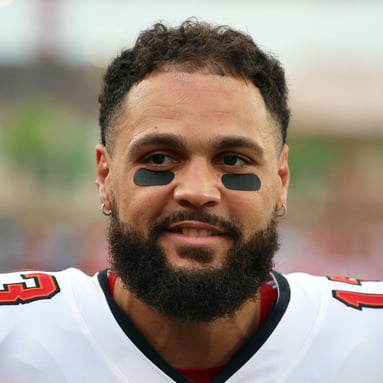
A hamstring strain arose in Week 3 and cost him the next three contests. Then came a concussion and broken clavicle (on the same play) in his Week 7 return, which sidelined the star wideout until Week 15. He made it through the remaining four games but played limited snap shares for at least two of them.
Evans appeared in just eight total games and reached 5 catches in a game only four times. He generated 36% of his receiving yardage for the season (132 yards) in the Week 15 loss to Atlanta.
That marked the only time all season that Evans finished higher than WR23. He landed among the top 30 just three other times.
You Might Know Evans from his Previous Work
Of course, we’re bothering to write about a 33-year-old receiver (as of Aug. 21) coming off a bad season because the rest of his career has gone pretty well.
Here’s how he ranked among WRs in PPR points per game leading up to 2025:
- 2014: 14th
- 2015: 22nd
- 2016: third
- 2017: 20th
- 2018: 10th
- 2019: fourth
- 2020: 16th
- 2021: ninth
- 2022: 16th
- 2023: 11th
- 2024: 11th
That’s seven straight years of top-16 production before last year’s injury debacle. And Evans navigated physical issues in many of those campaigns as well.
The hamstring segment of his injury history is particularly noteworthy. Evans has had a hamstring issue pop up in some form every season since 2019. He lost three games to a 2024 hammy injury. Before that, though, he missed just seven total weeks across his first 10 seasons.
2026 Presents Whole New Opportunity
Evans’ missed time has been backloaded in his career to date, but that doesn’t make it fluky.
Hamstring issues rank among the most worrisome for risk of recurrence, and the fact that Evans has lost three games to hamstring injuries each of the past two seasons certainly highlights a durability problem. Our Injury Predictor puts him at “High Risk” of missing some time in 2026. But his 5.00 Durability ranking also highlights Evans’ ability to play through more minor dings.
Now let’s get into why you shouldn’t simply ignore an old wideout with tattered hammies.
San Francisco Makes Rare Investment
HC Kyle Shanahan doesn’t typically import his target leaders. He drafts them.
The 49ers have not had a WR they didn’t draft rank among their top three at the position in targets since 2019, Shanahan’s third year on the job. Across his nine years in San Francisco, only Emmanuel Sanders in 2019 and Pierre Garcon in 2017 and 2018 have achieved that status.
The past couple of years, however, have seen the Niners allow Deebo Samuel and Jauan Jennings to walk, and descend into a feud with Brandon Aiyuk that has the wideout essentially gone. And the drafts since Aiyuk and Jennings arrived in 2020 haven’t quite replenished the supply.
| Year | Player | Round |
| 2022 | Danny Gray | 3 |
| 2023 | Ronnie Bell | 7 |
| 2024 | Ricky Pearsall | 1 |
| 2024 | Jacob Cowing | 4 |
| 2025 | Jordan Watkins | 4 |
| 2025 | Junior Bergen | 7 |
| 2026 | De'Zhaun Stribling | 2 |
That’s why the 49ers hit the market this offseason for:
- Evans: three years, $42.4 million, $14.3 million guaranteed
- Christian Kirk: one year, $3 million, $2.78 million guaranteed
The disparity between those deals highlights how highly the team values Evans, especially when you consider that he’s three years older than Kirk and clearly in the historical decline phase of the WR aging curve.
Evans the McCaffrey of Receivers?
That history gives us little basis for comparison at Evans’ position in San Francisco, but it harkens to another splashy move.
Shanahan’s offenses also used to be known for finding low-investment RBs and then wringing impressive production out of them. That dates back to before his San Fran tenure and even to the coaching career of his dad, Mike, and others from that Shanahan coaching tree.
But then the 49ers acquired Christian McCaffrey in 2022 and combined the top-shelf system with a top-shelf talent.
Evans will be seven years older when this season begins than McCaffrey was in 2022, so it’s obviously not a direct comparison (especially because they play different positions). But the point here is that the Niners didn’t pay up for an aging star WR just to give him a comfy place to end his career.
They’re chasing needed production.
Iffy Depth Chart Supplies Opportunity
Ricky Pearsall will miss the season after doctors determined he'd need surgery to repair the PCL that dogged him throughout 2025 and lingered into this summer.
That likely leaves Deebo Samuel as the season-opening starter opposite Evans. The team brought the veteran back after the Pearsall diagnosis.
Behind those guys, Kirk looks more like insurance than target threat. Rookie De’Zhaun Stribling will need to prove he’s ready for meaningful work, but he has generated buzz this summer. TE George Kittle also heads toward the season with some uncertainty around his recovery from a January Achilles’ tear.
McCaffrey obviously remains central to the offense and will continue to rank among the RB target leaders as long as he’s healthy, but there’s room for Evans to draw 20% or more of Niners targets this season.
Whatever share he gets will come in a pass offense that has finished five straight years among the league’s top 6 in net yards per pass attempt (which incorporates sacks). The team ranked top 4 in four of those seasons before missing QB Brock Purdy for eight games last year.
The 49ers have also ranked top-7 in total yards each of the past five years and top-13 in scoring each of those seasons.
Evans Might Need Vacated Targets to Hit Ceiling
If McCaffrey and Kittle play a full season and Samuel offers anything close to his previous Niners edition, then Evans might have a hard time climbing beyond WR2 territory in fantasy scoring -- with some risk that he lingers in WR3 land.
He should generate yardage and TDs at efficient clips, given his history and that of Shanahan’s system with Purdy behind center. The question will be target share, and that could mean inconsistent weeks. But most WRs present that weekly issue to fantasy managers.
An injury to any of those players, however, would vacate some target share, raise Evans’ fantasy ceiling, and potentially even boost his weekly floor.
The biggest risk here, of course, comes in the above-average chance that Evans loses some time to injury.
Draft Sharks Verdict:
It’s OK if you’d rather just pass on a 33-year-old WR with high injury risk. But this isn’t your average example on that front. Evans is closing out a hall-of-fame career, and he’s entering one of the league’s most dependably efficient offenses. He’s worth the risk at his low-WR2 ADP, especially if you land him as the third guy in a receiver-heavy start. If you do draft Evans, securing insurance at the position becomes more important than it might with other early-round wideouts.
Customize his projection for your exact league settings inside the Draft War Room.
Deebo Samuel
Decent 2025 Despite Challenges with New Team
The 49ers traded Samuel to Washington ahead of free agency last year for the fifth-round pick that became RB Jordan James.
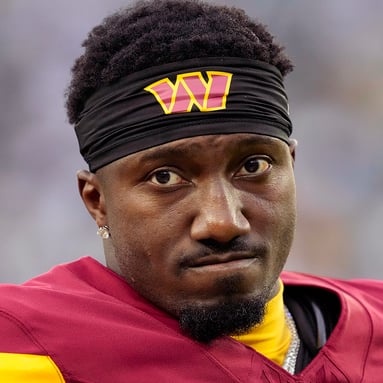
Samuel factored prominently into a Commanders offense that missed WR Terry McLaurin and QB Jayden Daniels for impactful stretches. Samuel’s 99 targets, 72 catches, 727 yards, and 5 TD receptions all led the team. He ranked 20th league-wide among WRs in target share.
Important to Note the QB Splits
Not surprisingly, Samuel fared better in games that Daniels played. Check out these splits for six games with the starting QB vs. 10 games without him:
| Stat | Daniels | No Daniels |
| PPR pts/gm | 14.2 | 10.3 |
| Tgts/gm | 7.7 | 5.4 |
| Rec/gm | 5.8 | 3.7 |
| Yds/gm | 50.0 | 42.7 |
| TDs/gm | 0.33 | 0.30 |
Samuel also ran the ball a bit more in non-Daniels games, averaging 1.4 carries across those contests vs. 0.50 when the starter played.
Overall, the wideout ranked 33rd in PPR points per game and 35th in expected PPR points per game. He posted five top-24 PPR weeks among 16 appearances, with four of those among the season’s first five contests.
Samuel also landed outside the top 50 six times, including three of the season’s final four contests.
Samuel’s Body Also Got in the Way
In addition to the QB challenge, Samuel likely played through a heel injury through much of the season. He only made the final injury report for that issue in weeks 6 and 7, missing the second of those contests.
Samuel notably went from 6.0 receptions per game through Week 5 to 3.8 per game from Week 6 on. And that five-game season-opening stretch included two weeks without Daniels in the lineup.
Even a Down Season Still Showed Upside
Samuel posted a career-low 10.1 yards per catch, which shouldn’t come as a shock for a 29-year-old WR on a new team, missing the starting QB for more than half the year, and with a well-populated injury history.
Samuel’s average target depth also dipped vs. the previous two years -- 5.5 yards, compared with 6.9 and 7.3, according to Pro Football Focus -- but was merely the third-shortest of his career. His yards after catch per reception also dipped to a career-low 6.5. That also shouldn’t be surprising given that it was Samuel’s first year outside a Kyle Shanahan scheme that’s historically good at maximizing after-catch production.
Samuel still went for 1.1 YAC per reception over expected, which ranked 14th among qualifying WRs. So he still proved good in that area, even if not as good as previously.
Samuel’s 1.66 yards per route ranked a decent 33rd among 76 WRs with 50+ targets. That marked a bump from his 1.60 in 2024 and marked the third season among his past four that finished in the range of 1.60 to 1.69.
We Can't Ignore the Injury History
Despite the heel injury, last year marked just the second time in his seven-year career that Samuel played at least 16 games. He had missed two or more in each of the previous three seasons.
Other recent ailments included:
- Calf strain, wrist, and rib/oblique injuries in 2024
- Shoulder fracture and a slight hamstring sprain in 2023
- Ankle sprain and MCL sprain in 2022
His injury reports are always worth watching.
2026 Finds Him Back Home
Pearsall’s Knee Struggles Create Space
Samuel spent most of the offseason lingering in free agency, but the 49ers re-signed him at the start of August after losing WR Ricky Pearsall to knee surgery. That opens an immediate starting opportunity, and Samuel reportedly chose San Francisco over other interested suitors. That points to the promise of opportunity.
The Niners imported WR Mike Evans in free agency, signed WR Christian Kirk to a small one-year deal, and drafted WR De’Zhaun Stribling at the start of Round 2.
Stribling has impressed in summer workouts, but he’ll need to prove he’s ready for a sizable role before pushing Samuel aside.
Evans also comes with his own spotted injury history, including some level of hamstring issue every season since 2019. There’s real risk that the 33-year-old (as of Aug. 21) will miss time at some point, which would boost the available targets.
TE George Kittle is coming off a January Achilles’ tear as well. There’s been plenty of optimism around his rehab, but the situation obviously presents a challenge against Kittle matching his usual performance level. That’s another path to potential opportunity.
Samuel Finds Familiarly Strong Scheme
Of course, we don’t have to guess nearly as much at Samuel’s fit as we might typically with a receiver joining a new team. He spent his first six pro seasons playing under Shanahan after the 49ers drafted him early in Round 2 in 2019.
Samuel has reached 100 targets in a season just once, averaged 60+ yards per game once (both in 2021) and never reached 5.0 receptions per game for a season. But he has enjoyed strong catch rates (66.7% career, 65.5% with San Francisco) and perennially stood out for his after-catch ability.
The three seasons Samuel shared with Brock Purdy before the Washington trade found him ranking third, first, and first in YAC per reception among WRs with 50+ targets. His ranks among WRs in PPR points per game for those seasons:
- 2022: 28th
- 2023: 14th
- 2024: 45th
Ceiling Looks Modest, But There's Utility Here
Samuel probably finished last season higher than you realize: 25th among WRs in total PPR points. But his scoring was front-loaded, as we addressed earlier. That, plus his time on the open market and lackluster final season in the first San Francisco run should keep his ADP down. And that’s key to addressing his fantasy outlook.
Samuel’s far from a lock to deliver regular starter-worthy weeks for the 49ers. But he does find opportunity, a scheme that has worked for him before, an accurate QB, and enough of his skill set remaining intact (based on last year’s metrics).
It’s probably not reasonable to dream of upside beyond WR3 range, but Samuel could remain a useful contributor in 2026.
Draft Sharks Verdict:
You shouldn’t be drafting the 30-year-old Samuel to start for your fantasy team, but that’s also not where his ADP sits. His low-WR5 cost means you can take a shot on the veteran in a familiar situation with multiple injury risks around him that present opportunity upside. He’s a solid reserve with a chance to deliver a usable WR3-level season.
Customize his projection for your exact league settings inside the Draft War Room.
George Kittle
2025 Delivered Numbers … and Trouble
Kittle sandwiched a pretty good 2025 campaign between a pair of nasty injuries.
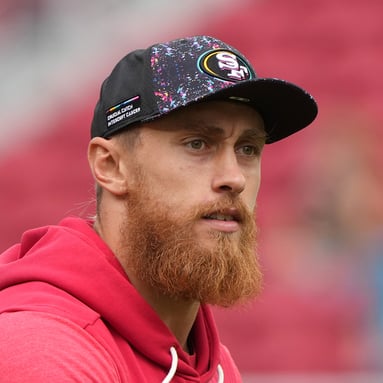
He left Week 1 with a hamstring tear that cost him five games. In true Kittle fashion, though, he jumped right back in at 81% playing time in his Week 7 return and climbed from there until a left ankle sprain cost him Week 17.
The other half of the injury sandwich, though, was a torn right Achilles’ tendon that knocked him out in the second quarter of the playoff win at Philly. We’ll get to the 2026 ramifications a little later.
Active Kittle Still Wins Weeks
When he took the field last season, Kittle fared well. His 14.7 PPR points per game ranked second among TEs, and he got there even with a zero in his Week 7 return game.
Kittle endured just two single-digit fantasy scores among his other 10 outings. He finished outside the weekly top 18 just twice overall and landed inside the top 10 seven times. That included five top-6 finishes among his final seven appearances.
Kittle beat his own points per game by 1.1 the year before and finished four other seasons averaging 14.1 PPR points per game or more. His annual PPG ranks at the position have gone:
- 2017: 24th
- 2018: third
- 2019: second
- 2020: third
- 2021: fourth
- 2022: second
- 2023: sixth
- 2024: first
- 2025: second
It didn’t hurt last season that Kittle drew his highest target share across four seasons since QB Brock Purdy arrived, ranking fourth at the position. That marked only a modest climb vs. the previous three years, though.
| Year | Share | Rank |
| 2022 | 17.8% | seventh |
| 2023 | 19.1% | seventh |
| 2024 | 19.4% | sixth |
| 2025 | 20.0% | fourth |
Kittle did post a career-low 4.5 yards after catch per reception last season, according to Pro Football Focus, despite a career-short 7.1-yard average depth of target. But his 2.11 yards per route still ranked fourth among 51 TEs who drew 30+ targets, and Kittle showed no other meaningful signs of performance decline.
The dip in yards after catch also seems plenty understandable for a guy who lost five early-season games to a hamstring tear.
Injuries Aren’t New Here
Kittle has only played every game once among his nine pro seasons, back in 2018. Since then, he has missed 2+ games in six of seven campaigns with injuries including these body parts: hamstring, groin, knee, calf, foot (fracture), knee.
2026 Presents Challenging Questions
We should expect some time lost to injury with this guy. But the new factor this season will be figuring out how to treat the Achilles’ issue he’s bringing from January.
Recent history doesn’t give us much help in judging what performance level we can expect from Kittle coming off this injury. The most recent examples of fantasy-relevant pass catchers returning from Achilles’ tears appear to be:
- Demaryius Thomas in 2011
- Michael Crabtree in 2013
Thomas’ injury occurred in February of that year. He wound up missing the first five games of that season and then averaging just 2.9 catches per game across 11 appearances. But that was also just his second year in the league (and he averaged a mere 2.2 catches per game the year before).
Crabtree tore his right Achilles’ in May 2013. He would play just five games that season and then see his yards per catch dip to a career-low 10.3 the following year.
Given that we’re now 13+ years beyond both situations, it’s fair to assume surgery and treatment have advanced to the point that those cases might be totally irrelevant for projecting Kittle.
Focus on Kittle’s Activity First, But There are Other Factors
Kittle said in June that Dr. Neal ElAttrache told him at the time of the surgery, “Hey, I think if you do everything the right way, you have a chance [to play Week 1].”
Kittle has certainly been a “do everything the right way” type in terms of offseason prep throughout his career and has remained optimistic for his return timeline. We’ll obviously have to track reports on his practice participation and performance right up until he actually plays in a game, though.
And this is about more than just whether he plays. Here’s how ESPN film guy Ben Solak puts it: “Tight end isn’t a position that demands quick and explosive movements, but Kittle has been the preeminent big-play tight end since he entered the league. His 13.5 yards per reception leads all tight ends over the past four seasons.” That even includes Kittle’s career-low 11.0 yards per catch last season.
Any loss of explosiveness -- and we should expect at least some coming off the Achilles’ tear -- will lower his fantasy ceiling.
Niners Add Target Challengers
Another potential risk factor is the altered depth chart of pass catchers. San Francisco gave WR Mike Evans $14 million per year on a three-year deal in free agency. The team will miss WR Ricky Pearsall (knee surgery) but quickly signed Deebo Samuel after losing Pearsall. And the Niners drafted WR De’Zhaun Stribling at the top of Round 2 and signed WR Christian Kirk to a small, one-year contract.
That crew won’t marginalize an active Kittle, but they could certainly cut into his target share. Fewer targets at decreased efficiency would challenge the high ceiling we’ve come to expect.
Kittle will at least remain in one of the league’s most consistently efficient offenses. San Francisco has finished five straight seasons among the league’s top 6 in net yards per pass attempt (which incorporates sacks). And the Niners should get more Brock Purdy than they had last year, when he missed eight games with turf toe.
DraftSharks Verdict:
Kittle’s situation will bear watching right up until your draft day. If he’s on track to play Week 1, then it’s easy to make the upside case for a guy who typically finishes top 5 among TEs and is now going ninth at the position in ADP. If Week 1 and other early games are in doubt, however, it’s a tough position at which to carry two starter types for many fantasy formats. In short: This decision will depend heavily on both how Kittle’s summer progresses and the specifics of your situation. See what the Draft War Room says for your draft, and consider how interested you are in taking on this risk-reward equation.
Customize his projection for your exact league settings inside the Draft War Room.